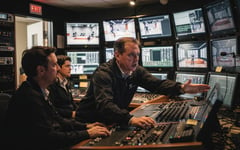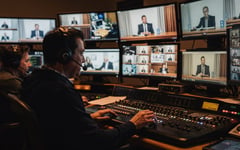

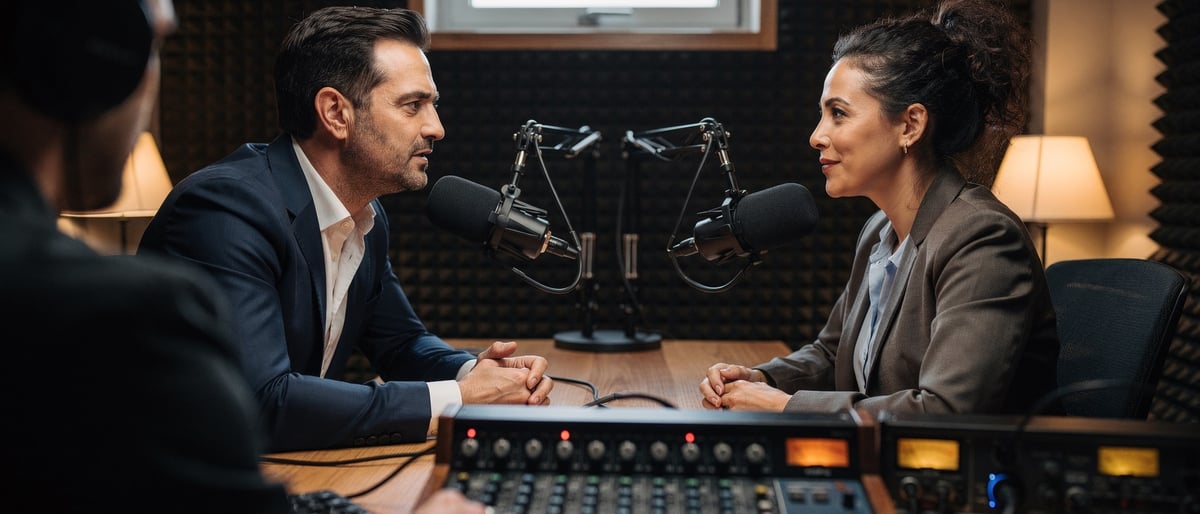
The brief was a simple one. One subject, two cameras, a conversation about leadership transitions. Forty minutes of material that would be cut to six. The client wanted it clean and professional.
What they had not thought about was how they wanted it to sound.
We were at the studio on a Tuesday morning. The green screen was up, the cameras were set, and the subject had cleared his sound check. Standard setup. But before we rolled, our senior audio engineer paused.
"Do you want to try something?" he said.
Trying something at the studio
He had been running tests with spatial audio processing on location shoots for the previous two months. The principle is straightforward: instead of placing every voice in the same flat stereo field, you position each source in three-dimensional space. The listener's brain reads left, right, near, far. It works on ordinary speakers as well as headphones. The effect is not obvious. The interview just sounds like a room.
We shot two passes. Flat stereo first, then with the spatial processing applied. Same questions, same answers, same camera positions. The client was not in the room for either pass. We played both back in the edit suite that afternoon.
What they heard
A flat stereo mix is clean and balanced, but it sounds like every polished corporate interview, professional and somehow distant. The listener observes rather than feels present.
The spatial mix positions each voice in three-dimensional space, so the brain treats the audio as a real environment. The viewer stops leaning back and feels in the room.
The stereo version was well recorded. Clean, balanced, every word audible. It sounded exactly like a polished corporate interview, which meant it sounded like every polished corporate interview anyone in that room had ever sat through. Professional. And somehow distant.
The spatial version sounded like a conversation. The interviewer's questions arrived from slightly left of centre. The subject's voice sat forward and grounded. When a pause came before an answer, the silence had weight behind it. You could feel the space the two of them occupied.
"It sounds like you're actually in the room," the client said.
She was right, though she did not know why. What the spatial mix does is give the listener's auditory system the information it expects from a real conversation. The brain stops processing the audio as a recording and starts treating it as an environment. The viewer does not lean forward consciously. They just stop leaning back.
That is the difference flatness makes. Not whether the content is good or bad, but whether the listener feels present in it. A flat stereo mix tells the brain: this is something to observe. Spatial audio tells the brain: this is somewhere you are.
Why most corporate video does not address this
Production budgets for corporate content tend to be built around what is visible. Camera package, lighting, set, talent, location. Audio gets a line item for the boom operator and another for post-production cleanup. The assumption is that clean audio is good audio.
Clean is necessary. It is not sufficient. A voice that is noise-free and perfectly equalised can still feel like a voice arriving from inside a box, sitting on the same two-dimensional plane as the background music, the room tone, and everything else in the mix. The listener does not identify the problem consciously. They just disengage slightly, feel less connected to the person speaking, and move on a little sooner than they would otherwise have done.
For most types of corporate content, this is a modest cost. A product explainer, a training module, a compliance overview: these work fine in flat stereo. The viewer needs information, not presence.
But for a leadership address, a culture piece, a CEO asking three thousand people to trust a change of direction, the distinction is not cosmetic. The content is asking the viewer to feel something, not just hear something. A flat mix undermines that ask without the viewer knowing why.
What changed in the edit
The six-minute cut came together faster than I expected. When you introduce an unfamiliar element into a post-production workflow, the edit can slow while the team finds its footing. The spatial version worked the other way.
Because the voices occupied distinct positions in space, moments landed more cleanly. A pause carried weight. A shift in the subject's tone was easier to read. The decisions about what to include and what to cut were more obvious, because the texture of each moment was more distinct.
The client's internal approval took two rounds. For a leadership piece going to three thousand staff, that is fast. The feedback was that it felt authentic. Genuine. Nobody used the word audio. Nobody mentioned what had changed technically. They just signed off with more confidence than usual, and the note said the piece felt human.
That is exactly what you want the note to say.
The brief that most teams do not write
When a business plans a corporate video interview, the questions tend to be about substance: who will speak, what they will cover, how long it should run. The question of how the viewer should feel sitting with that person rarely comes up explicitly.
Audio answers it. We had been producing corporate video london work long enough to know which decisions tend not to make it into briefs. This was not a new technology discovery; it was a decision to apply something available to the right kind of brief. A brief that was about trust, presence, and the quality of connection across a screen.
The processing cost nothing beyond the engineer's preparation time and an extra hour in post. The equipment was already in the studio. What it required was the awareness that sound is spatial, that the human ear has been reading three-dimensional information since before language, and that a mix that ignores this is asking the ear to work against itself.
When spatial audio matters and when it does not
We now raise the question on every interview brief that involves trust-building. Not every brief needs it. A technical explainer, a product walkthrough, a training module: these call for clarity above all else, and flat stereo delivers that efficiently.
An address to staff during a difficult period, a CEO video, a leadership panel, a testimonial from a client who is trying to convey conviction: these call for presence. The viewer needs to feel they are with someone, not watching someone. The audio is where that difference lives.
If you have an interview scheduled and want to talk through the approach before you confirm the date, it is worth raising in the brief. The conversation takes ten minutes.
Frequently asked questions
What is spatial audio in a corporate interview?
Instead of placing every voice in the same flat stereo field, spatial processing positions each source in three-dimensional space, so the listener's brain reads left, right, near and far. It works on ordinary speakers as well as headphones.
Does spatial audio need special playback equipment?
No. The effect works on ordinary speakers as well as headphones. The interview simply sounds like a real room rather than a recording.
When is spatial audio worth using?
It matters for content that asks the viewer to feel something, such as a leadership address, a CEO video or a testimonial. A technical explainer, product walkthrough or training module calls for clarity above all, and flat stereo delivers that efficiently.
How much does spatial audio add to a production?
In this case it cost nothing beyond the engineer's preparation time and an extra hour in post. The equipment was already in the studio.
How do I raise spatial audio for my interview?
If you have an interview scheduled, raise it in the brief before you confirm the date. The conversation takes about ten minutes.