
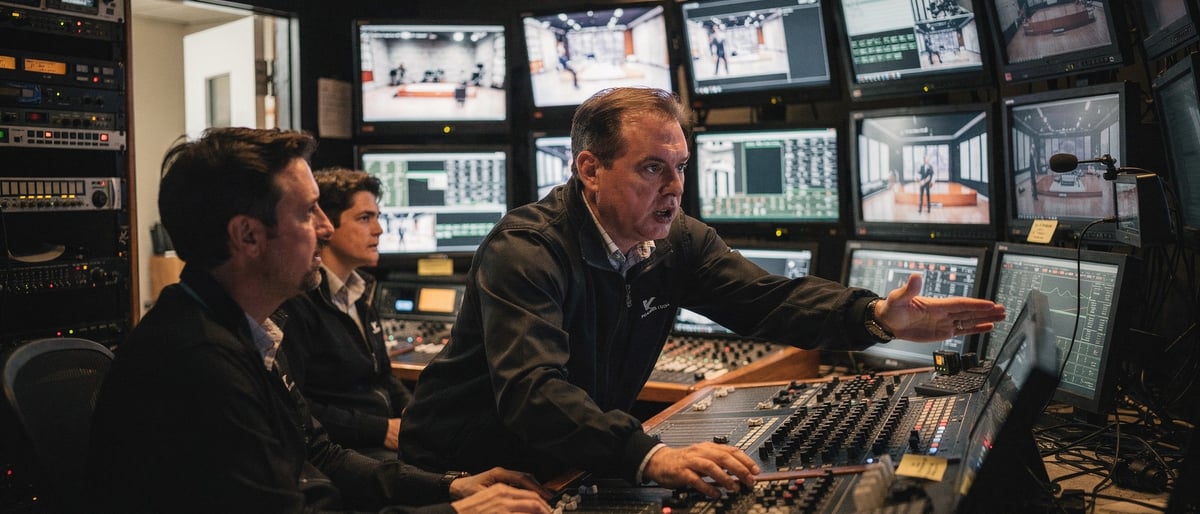
The call sheet had us at eight. The client arrived at half eight.
Not unusual. In any given week of virtual studio productions, someone is late to rehearsal. What changes is how badly that half hour costs them when we go live.
That morning we were producing a company-wide broadcast for around four hundred staff. The CEO was presenting. She had done plenty of on-camera work before and said as much when we proposed the rehearsal schedule. Two hours felt like a lot. She would rather skip straight to the real thing.
We held the line.
The moment the gap closes
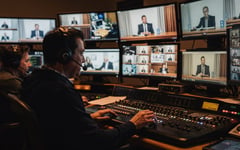
By the time she arrived, the floor was already dressed: camera blocking taped, teleprompter loaded, the virtual background composited on the director's monitor so she could see the finished picture rather than guess at it. The green fabric behind her told her nothing. The screen at the back of the set showed her everything.
She stood at the mark, looked at the monitor, and said, "Oh."
That "oh" is the moment we build rehearsal around. It is not about confidence. It is about the gap between what someone imagines and what they actually see when they are standing in front of a green-screen stage for the first time. You cannot close that gap in a briefing document. You can only close it in the room.
What rehearsal is actually for
Most people think rehearsal is about remembering lines. For scripted work, that is partly true. For live broadcasts and executive interviews, it is something else entirely.
Posture shifts when someone sees themselves on a monitor. Eyeline shifts. Vocal energy drops, then climbs too high, then settles. A person who presents confidently in a meeting room can lock up on a production floor the first time they stand at a mark and realise four hundred colleagues are about to see this.
In the virtual studios London setup we use for this kind of work, the background compositing is visible in real time on a confidence monitor. That is genuinely useful for the presenter. They can see when they drift out of the clean background zone. They can see their own framing. On a well-designed stage, that feedback loop closes the gap between what the presenter thinks they look like and what the camera is actually capturing.
But you only get the benefit of that loop if you give it time to run.
One rehearsal pass is usually not enough. The first pass is diagnostic. The presenter is still orienting, still working out where to look, still deciding what to do with their hands. We observe, we note, and we start a list. The second pass is where the real calibration happens.
The things that go wrong when you skip it
The CEO that morning was a good presenter: articulate, calm, clear. The first run-through still surfaced three things we needed to fix before we went live.
Her eyeline was low. She was reading off the teleprompter scroll at the rate it had been set for a different voice pattern, so she was always chasing it slightly, chin angled down. We reset the scroll speed. Five minutes.
Her lapel mic was picking up fabric rustle when she turned. The sound engineer moved it two centimetres. Two minutes.
The background was designed to show a meeting space with depth. When she stood straight, it worked. When she leaned forward to emphasise a point, her shoulder clipped the edge of the keyed zone and the background broke. We moved the camera mark back forty centimetres. The shot reframed cleanly. Ten minutes of work.
None of those fixes are catastrophic on their own. Together, they are the difference between a broadcast that looks effortless and one where something always feels slightly off. Viewers rarely identify what is wrong. They just know something is.
Skip rehearsal and the low eyeline, the mic rustle and the broken background all make the final cut. The CEO would feel vague dissatisfaction with something she could not name.
Run rehearsal and the same three issues are found and fixed before going live. The framing is clean, the eyeline is direct and the mic is silent.
Skip rehearsal and all three make the cut. The CEO would have watched the edit back and felt vague dissatisfaction with something she could not name. The thing she could not name is the thing we found in the rehearsal.
The time argument
Clients push back on rehearsal time because it looks like the same cost as production time. It is not.
Catch a mic position in the offline edit and it takes two extra days, a re-record, a rebooking and a schedule that slips.
Fix a mic position in rehearsal and it takes five minutes. An eyeline is one director conversation and one prompt-speed adjustment.
A two-hour rehearsal on a half-day studio booking is the cheapest quality control we offer. Fixing a mic position takes five minutes in rehearsal. It takes two extra days if you catch it in the offline edit and need to send someone back to the studio. Fixing an eyeline takes one director conversation and one prompt-speed adjustment in rehearsal. In post, it is a re-record, a rebooking, and a schedule that slips.
The embarrassment risk runs the same way. A stumbled line in rehearsal is invisible. A stumbled line in a live broadcast to four hundred staff lives in the company's institutional memory for a long time.
We have never had a client come back from a live broadcast and say the rehearsal was wasted time. We have had plenty say they wished it had been longer.
How we run it
The floor is live from the moment the presenter arrives. Monitor feeds up, background composited, teleprompter loaded to their scroll speed from the briefing call. We walk through the full show in running order, not sections. We note, we adjust, and we run it again.
The director watches for technical issues, eyeline drift, and anything that will read badly on camera in the first pass. The presenter gets feedback on exactly two things: framing and eye contact. Everything else waits.
By the third pass, most presenters have found the version of themselves that the camera responds to. It is usually quieter than they expected, more direct, slightly slower. That version does not exist at the start of a session. It is built by doing the work, on the floor, before anything is at stake.
That is why we hold the line on rehearsal time, even when the client is confident, even when the schedule is tight, and even when the CEO arrives half an hour late.
She broadcast to four hundred people that afternoon. The framing was clean, the eyeline was direct, and the mic was silent. She watched the recording back the following week and asked if we could do the same format for the next quarter.
She did not mention the rehearsal. She did not need to.
[Check studio availability and we'll build the rehearsal time in from the start.]
Frequently asked questions
Why does a confident presenter still need a rehearsal?
Posture, eyeline and vocal energy all shift the first time someone sees themselves on a confidence monitor. A person who presents well in a meeting room can lock up on a production floor, and that gap only closes by standing on the stage.
How long should a virtual studio rehearsal take?
We allow around two hours on a half-day booking. The first pass is diagnostic and the second is where the real calibration happens, with most presenters settling into their on-camera version by the third pass.
Is rehearsal time the same cost as production time?
No. A two-hour rehearsal is the cheapest quality control we offer. Fixing a mic position takes five minutes in rehearsal but two extra days if you catch it in the offline edit.
What actually gets fixed during a rehearsal?
Things that read badly on camera but rarely get named by viewers, such as a low eyeline, a lapel mic picking up fabric rustle, or a shoulder clipping the edge of the keyed green-screen zone.
What happens if we skip the rehearsal entirely?
The small flaws make the final cut and the broadcast feels slightly off without anyone being able to say why. We have never had a client call the rehearsal wasted time, though plenty wished it had been longer.