
We had a client cancel the second interview slot before we'd even unpacked the second camera.
The executive who hated the footage
Their communications director rang during the lunch break. The head of sales had done the morning session, sat very still, chosen every word carefully, and produced twelve minutes of footage that looked and sounded exactly like a corporate video. Which was precisely what we'd been commissioned to make. He hated it.
Not the footage, specifically. He hated how he looked in it. He said he didn't recognise himself.
I've been in this long enough to know what that means. It means we put him in the wrong format.
The wrong frame for the right person
The standard executive interview setup hasn't changed much in fifteen years. Single camera, slight angle off-axis, interviewer just out of frame, background dressed to signal competence. It produces clean, consistent footage. It also, in a significant proportion of cases, produces footage where the subject looks like they are reciting prepared answers in a room designed to make them nervous.
Because they are.
The head of sales was a good communicator. Anyone who'd watched him present to a room knew that. But the setup we'd put him in asked him to perform "authoritative executive", and he'd obliged. The result was technically fine and personally humiliating.
I went back to the studio that afternoon and pulled up the corporate video London brief again. They wanted content for the website, internal communications, and LinkedIn. Three to four minutes per person, six executives, all senior, all experienced in live settings. None of them were going to be comfortable in a standard talking-head format.
We shifted everything.
The conversation set
Single camera, slight angle, interviewer out of frame. The subject performs authoritative executive and looks like they are reciting prepared answers in a room built to unsettle them.
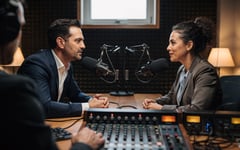
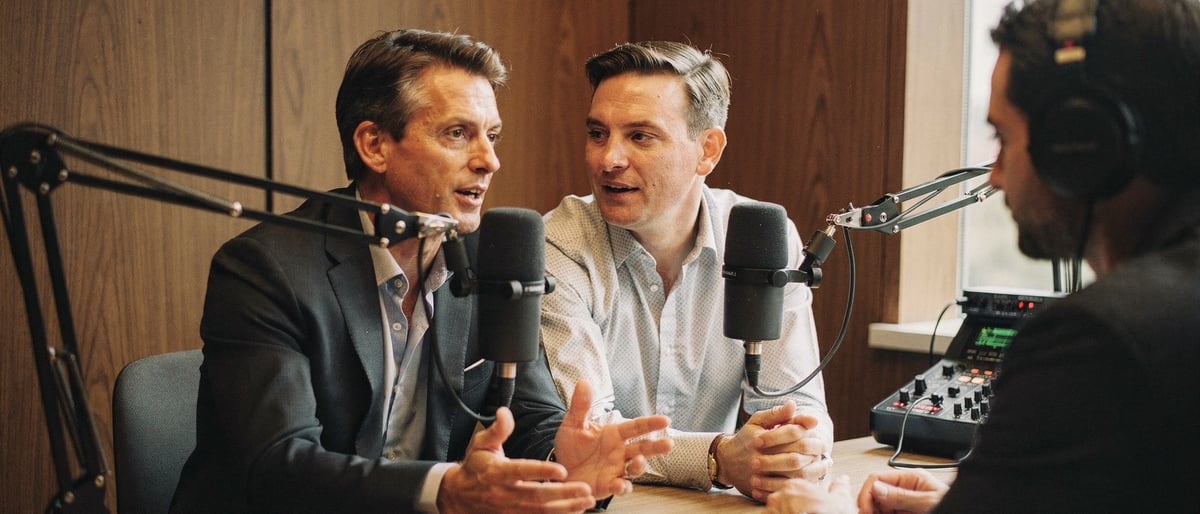
Two chairs at a slight angle, both on camera, an interviewer on screen. The subject responds to a person three feet away and the social contract of the room changes.
We rebuilt the setup as a podcast-style conversation: two chairs at a slight angle to each other, both on camera, an interviewer who appeared on screen rather than hiding off to the side. The set was designed around the format. Lower cameras, closer framing, two lapel mics and a boom for clean pickup in either direction.
The change it made was not technical. It was psychological.
When two people are talking to each other, the social contract of the room is different. The subject is no longer performing for an invisible audience. They are responding to a person sitting three feet in front of them. The answer to "what does good onboarding actually look like?" is different when it is addressed to a colleague than when it is addressed to a camera and an unseen viewer.
The head of sales came back the following morning for a thirty-minute conversation. We used eleven minutes of it. He watched the rough cut back and said, "That's me."
That is the outcome I want from every shoot. Not technically excellent footage of someone performing competence. Footage of someone who is actually competent, being themselves.
What changes in a conversation format
The hands are the first thing. Executives in a standard interview setup often don't know what to do with them. They end up gripping the chair arms or folding their arms in ways that read as anxious or defensive on camera. In a conversation set, hands come alive. They explain things, they count points, they move naturally because that is what hands do when someone is actually talking to another person.
Eyeline is the second thing. Off-axis, slightly to camera, is a trained presentational skill. Most people have never practised it. Looking at another person in a conversation is something everyone does without thinking. The footage reads differently because the cognitive load of performing for camera has been replaced by the cognitive load of having a conversation.
The third thing is pace. Talking heads in a standard format tend toward a slightly slowed, considered rhythm. It sounds authoritative. It sounds like they're choosing every word. Which they are. Conversation is faster, more varied, and more believable because it is genuinely responsive.
None of this means the interviewer's questions don't matter. They matter more. In a good conversation set, the interviewer has to be skilled enough to hold the frame, move the subject through the content, and ask follow-ups that make the subject think rather than recite. When it works, you can't see the structure at all. You just see a person who knows what they're talking about, talking about it.
The question worth asking first
Before we accept a brief for executive interviews now, we ask one question: where does this person communicate well?
If the answer is "in presentations", we build a presentation format. If the answer is "in meetings", we build a conversation. If the answer is "they're fine on camera", we'll find out during the recce, and then we'll have the conversation anyway.
The format is not a style choice. It is a question about where the person is most themselves, and then a question about how to make the camera go there with them.
I heard from the communications director six months after that shoot. The LinkedIn clip from the conversation format had more engagement than anything else the company had posted that year. She wasn't sure why it had worked so well.
I was. It was because he looked like himself.
[See the studio and find out which format suits your next brief.]
Frequently asked questions
Why does a podcast-style set make executives look more natural?
When two people talk to each other, the subject responds to a person rather than performing for an unseen camera. Hands, eyeline and pace all become more natural because it is a genuine conversation.
Does the conversation format suit every executive?
No. Some people communicate best in presentations, so we build a presentation format for them. The set should match where the person is most themselves, which we work out before the shoot.
How long does a conversation shoot take per person?
A thirty-minute conversation gives plenty of usable material. In one case we used eleven minutes of footage from a single thirty-minute session with the head of sales.
Does the interviewer matter more in a conversation set?
Yes. The interviewer has to hold the frame, move the subject through the content, and ask follow-ups that make them think rather than recite. When it works you cannot see the structure at all.