
The cab pulls up and you walk in to find the crew ready, the lights up, and the set looking exactly as you discussed. That calm is not accidental. It is the result of an hour's work you weren't there for.
I'll tell you what that hour looks like, because understanding it changes how you plan a shoot and what you ask of your production team.
Load-in begins before you know it
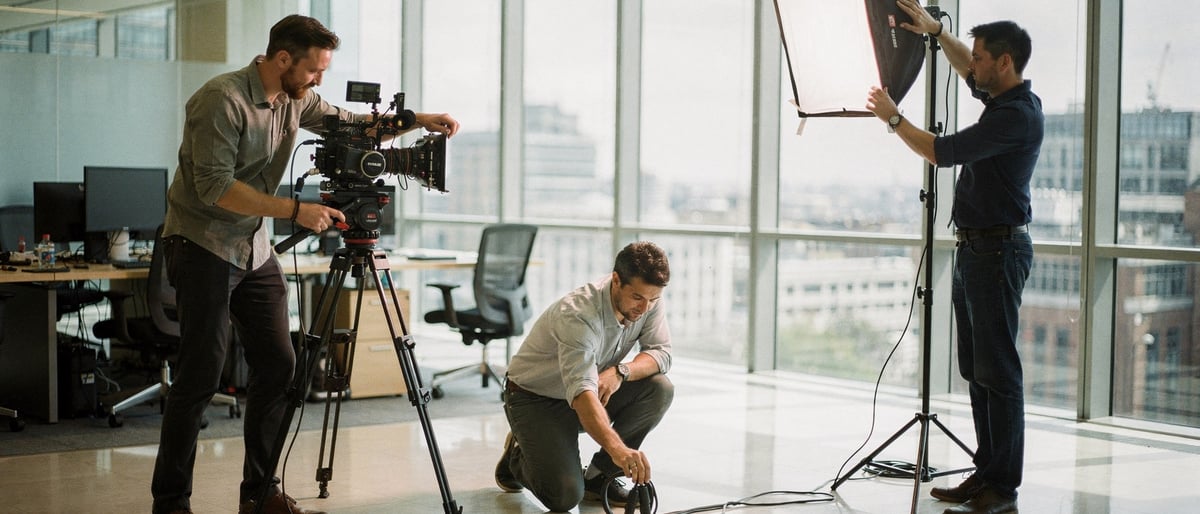
A crew call on a filming day around the Southbank or central London typically runs ninety minutes to two hours before the client arrives. For a 09:00 first shot, that means a 07:00 or 07:30 load-in. The gaffer and their team arrive first, because nothing else can happen until the power is confirmed and the base lighting is up.
In a space you've used before, this is muscle memory. In a new location, it is a careful read of the room. Where are the distribution boards? What are the constraints on the ceiling rig? Is there ambient light from a window that will shift between 09:00 and 14:00, and if so, which way? Every decision in that first thirty minutes shapes what's possible for the rest of the day.
The camera team follows, setting up the A-camera position from the shot list while the focus puller checks the lenses against the morning's planned focal lengths. If we're running a green-screen virtual studio setup, the lighting on the cyc has to be even within a tolerance that leaves room for compositing. Too hot in one corner and you're fighting it in post. That's measured, not guessed.
The things that get checked twice
Sound arrives and does a sweep of the room before any talent steps in. In a London location, Southbank or otherwise, you may have ambient noise that didn't register on the recce: building HVAC, river traffic, a road drill one block over that wasn't there when you came to look. The sound recordist will know inside ten minutes whether there's a problem and whether it's solvable with repositioning, acoustic treatment, or a scheduled break in recording when the source pauses.
A column where blocking assumed clear space, spotted at 09:15 with the client standing there, becomes a different kind of conversation.
The same surprise caught at 07:45 against the actual room is a small adjustment, made before anyone walks through the door.
We check the run sheet against the actual room. Not because anyone doubts the plan, but because rooms have a way of presenting surprises: a column where the blocking assumed clear space, a floor level that affects sightlines, a background element that changed since the recce. Catching these at 07:45 is a small adjustment. Catching them at 09:15 with the client standing there is a different kind of conversation.
The producer or first AD walks through the day's sequence, confirms the order of setups, and flags anything that needs talent prep time. If there are graphics or playback elements, those get tested on the actual monitors that will be in shot, not on someone's laptop.
The equipment you won't notice
The prompter, if there is one, gets positioned and calibrated so it disappears to the viewer while remaining readable to the presenter. This takes longer than most clients expect and has a bigger effect than most realise. A presenter reading from an uncomfortable angle reads as nervous. A presenter reading from a well-positioned prompt reads as themselves.
Wireless comms between the director and the floor get tested. IFB feeds if the director is off-camera. Talkback to a remote gallery if we're running a live element. All of this exists to make the shoot feel simple for the person in front of the camera. The complexity lives in the system so the performance doesn't have to carry it.
The first impression of the set
Catering, if it's on set, is ready before the client arrives. Coffee available from the moment they walk in is not a nicety. A cold room with no refreshments and a crew looking busy in the corner is an energy that clients absorb. The first impression of the set is the first impression of the day, and it should tell you: the people here know what they're doing and expected you.
What this means for you
If you're working with a professional London crew on a filming studios shoot around the Southbank or in a controlled studio environment, the hour before you arrive is when they earn their day rate. You're not paying for their presence in the room; you're paying for the decisions they made in the hour before you got there.
A first-time crew discovers the Southbank's access windows, light conditions and neighbouring events on your job, on the day.
A crew that knows the circuit builds those windows and light shifts into the load-in before the day starts.
This is also what distinguishes crews who know this circuit from those who are learning it on your job. The Southbank in particular has its own production cadences: access windows, light conditions, neighbouring events that require coordination. A crew that has worked there before knows to build specific things into their load-in that a first-time crew discovers on the day.
When you're briefing a production, ask about the load-in plan as specifically as you ask about the shot list. Ask how long the crew call is, who arrives first, and what the tech run covers. A detailed answer tells you whether the hour before you arrive is being thought about as carefully as the shoot itself.
The hour that holds the day
Every clean shoot day I've worked starts with an hour nobody saw. That's not a mystery to protect; it's a process to respect. When you understand what's happening on the other side of that door before you walk through it, you become a better client and you make better decisions about who you book.
If you're planning a filming day in London, talk to us about what the production prep looks like. That conversation is where the day is actually built.
Frequently asked questions
How early does a London crew arrive before the client?
A crew call typically runs ninety minutes to two hours before the client arrives. For a 09:00 first shot that means a 07:00 or 07:30 load-in, with the gaffer's team in first to confirm power and base lighting.
What gets done in the hour before I walk in?
Power and base lighting go up, the camera and focus are set against the shot list, sound sweeps the room for ambient noise, the run sheet is checked against the actual space, and any prompter, comms and playback are tested.
Why does the load-in plan matter when I brief a shoot?
The hour before you arrive is where the crew earns its day rate. A detailed answer on crew call, who arrives first and what the tech run covers tells you the prep is being thought about as carefully as the shoot.
Does shooting on a green-screen virtual studio change the prep?
Yes. The lighting on the cyc has to be even within a tolerance that leaves room for compositing. Too hot in one corner and you fight it in post, so it is measured at load-in, not guessed.
Why pick a crew that already knows the Southbank?
The Southbank has its own production cadences: access windows, light conditions and neighbouring events that need coordination. A crew that has worked there before builds those into the load-in rather than discovering them on your day.