
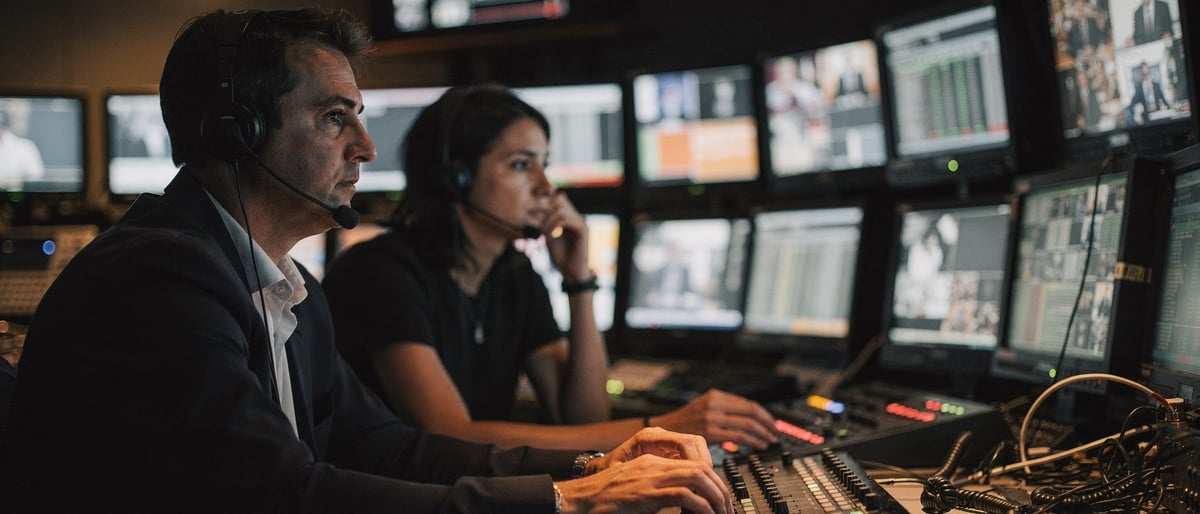
During a live broadcast, the director on our virtual studio floor is watching between eight and twelve monitors. The audience sees one.
The gap between those two numbers is where a broadcast holds together or falls apart.
I have been directing live productions long enough to know that the viewers who compliment the quality of a show rarely describe what they actually saw. They say it felt professional, it felt polished, or it felt easy. What they mean is that nothing surprised them in a bad way. They experienced the version of the show where the rough edges were caught before the frame reached them.
Here is what I was watching to produce that experience.
The confidence monitor
The production feed in the control room looks clean, so the team assumes the audience is receiving a clean signal too.
The confidence monitor decodes the actual output a viewer receives, catching artefacts, dropped frames or audio sync drift before countdown.
The first thing I check at the top of every show is the confidence monitor: the actual stream or output signal, decoded and playing as a viewer would see it, not as it exists before compression. This matters because your production feed can look clean while the encoded output has artefacts, dropped frames, or audio that is slightly out of sync with the picture.
We had a show three years ago where the first six minutes of an executive address were broadcast with a 200-millisecond audio delay. The production feed in the control room was perfect. The confidence monitor, which I had not checked before countdown, would have caught it immediately. The client's audience noticed. The client noticed more.
I have not skipped the confidence monitor since.
Camera feeds and the cut you have not made yet
An audience watching one camera feed only ever sees the cut that has already been made on screen.
The director watches the three cuts not yet made, positioning the next shot so it lands on the right face at the right moment.
On a panel discussion from our virtual studios in London, I will typically have four cameras running. The cut I have made is what the audience sees. What I am watching is the three cuts I have not made yet.
Camera two has a guest who is about to speak. Camera three has a clean wide shot that will let the presenter breathe after a long segment. Camera one has a close-up I want for the close of an answer, if the answer lands where I think it will.
Directing live is managing probability. You cannot know exactly what a guest will say, but you can watch their body language, listen to the shape of their sentence, and position your cut so that you land on the right face at the right moment. Most of that judgment happens in the four seconds before you press the button.
The compositing view
In a green-screen virtual studio, the director watches a separate compositing monitor showing how the chroma key is behaving in real time. A clean key looks effortless on camera. A troubled key has a faint fringe around the presenter, or loses edge definition when they move quickly.
The compositing monitor is the canary. If the key is drifting, the lighting has shifted, usually because a practical on the set has heated up and changed colour temperature, or the presenter has moved into a shadow they rehearsed around. We address it before the cut lands on that camera.
The host and the guest never know this is happening. That invisibility is the point.
Audio
I am watching a peak meter for every open channel throughout the broadcast. Not because I do not trust the sound operator, but because the director is the last person in the chain before the audience, and the first person in a position to hear the whole picture rather than its parts.
Audio tells me things the video does not. A presenter whose levels are riding lower than they were at the top of the show is often signalling fatigue or nerves. A guest who has moved away from their microphone is about to become difficult to hear. A room tone that has changed means something in the physical space has changed.
You develop a relationship with the meters over time. They stop being numbers and start being signals about the room.
The clock
Always the clock. A live broadcast has a shaped run order for reasons that are not always visible in the room. Legal compliance windows, sponsor commitments, audience handovers, hard stops on external platforms that cut the stream regardless of where you are in the show.
The director's job is to run to time without the host ever feeling rushed. That means absorbing the schedule quietly, banking time in the early segments when the conversation allows it, and knowing which elements of the run order have genuine flex and which are walls.
When a panel goes long and I need thirty seconds back before the break, the host does not receive a note and the audience does not see a gesture. The adjustment happens at a natural sentence break. The panel does not lose its rhythm. The clock is satisfied.
What this looks like from the floor
If you have watched a broadcast from our virtual studios in London and thought it felt calm, that is not an accident. Calm is the output of a director managing a complex feed without making the complexity visible to the people on camera or the audience watching.
The monitors I described are tools. The judgment about what to do with what they show is the job. The two are only as good as each other.
If you are planning a live broadcast and thinking about which elements of the production matter most, the answer is usually the ones you cannot see from the audience's chair. Book a studio where the director has encountered every failure mode you cannot anticipate. That preparation is what keeps your audience's experience clean from first frame to last.
Frequently asked questions
Why does a director watch so many monitors during a live broadcast?
Each monitor surfaces a different failure mode the audience never sees. The director watches the confidence monitor, the camera feeds, the compositing view, the audio meters and the clock so the rough edges are caught before they reach the frame.
What is a confidence monitor and why does it matter?
A confidence monitor shows the actual encoded output a viewer receives, not the clean feed inside the control room. It catches artefacts, dropped frames or audio that is slightly out of sync before the show goes live.
What does the director watch in a green-screen virtual studio?
A separate compositing monitor shows how the chroma key is behaving in real time. A drifting key signals a lighting shift, so the director addresses it before the cut lands on that camera.
How does a live broadcast run to time without feeling rushed?
The director absorbs the run order quietly, banking time in early segments and knowing which elements have genuine flex. Adjustments happen at natural sentence breaks, so the host and audience never feel the schedule being managed.
What should I look for when booking a live broadcast studio?
Book a studio where the director has encountered every failure mode you cannot anticipate. The elements that matter most are usually the ones you cannot see from the audience's chair.