
The production manager called at 3pm on a Wednesday. Their studio had double-booked Friday, the original space was gone, and the launch film needed to be on YouTube by end of week. Could we help?
We said yes. This is what the next forty-eight hours looked like.
The brief we inherited
The brief was clean: a five-minute hero film for a SaaS product launch, featuring the CEO and two product leads, composited against a branded environment that matched the product's UI colours. The original studio had already agreed the concept. We were inheriting a thought-through brief, not starting from scratch. We had their style guide, a rough script, and the contact for their marketing director.
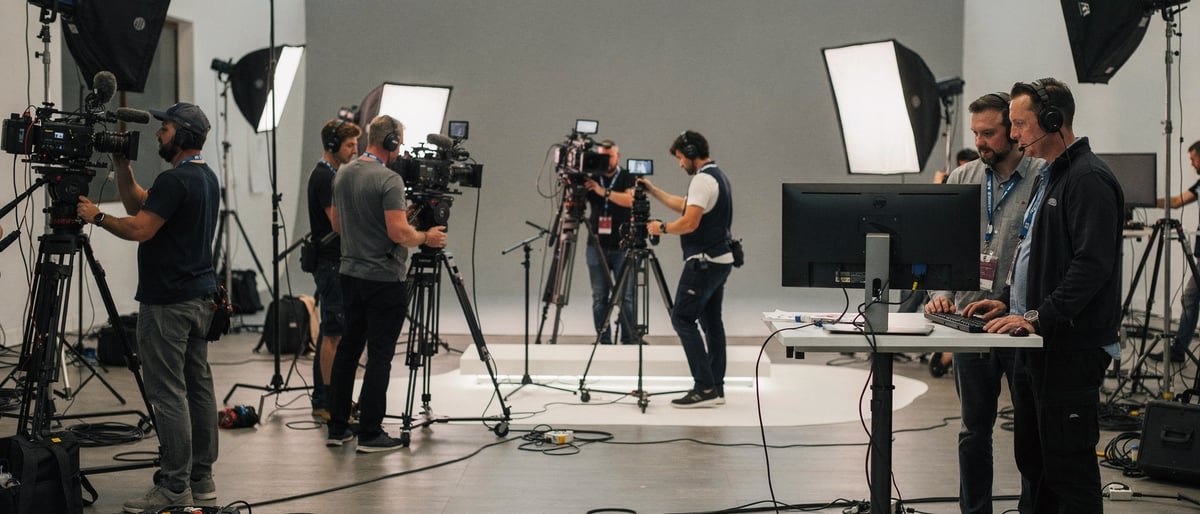
By 4pm on Wednesday we had a pre-production call. Three people on the client side, our compositing lead, and me. The session covered one thing: what we were each responsible for, by what time. We were building a green-screen shoot with a CG branded background that the client's design agency would supply as a still image. Our scope was lighting, camera, sound, and the composite. The agency was delivering assets by 10am Thursday.
We set the studio call time for 7am Thursday. That gave us two hours of technical setup before the files landed, and a shoot window from 10am through to 4pm with contingency built into both ends. The CEO arrived at 9:45. The product leads came in at 10:20.
Getting the subject ready before the camera is hot
While the compositing lead built the initial technical setup, we ran a short camera check with the CEO. Twenty minutes, no script. The aim is simple: get the subject talking before the camera is hot, so the nerves are spent before take one. Most people tighten up when they know they are being recorded. They loosen once they have already been recorded and the world did not end. We use that window every time, regardless of how experienced the subject is.
The agency files landed at 11:03. Thirty minutes late. In a forty-eight-hour window, that is not nothing. We made a call: run the CEO interview first, build the composite on a second system in parallel, and have the technical director sign off the background before the product leads stepped in front of the camera. If the composite came back wrong, we had an hour to iterate before we needed those two performing.
The CEO ran four takes. Two were usable. We went with the second. The composite cleared at 12:45. By 2pm we had clean footage for all three subjects. We wrapped at 3:10.
The edit ran overnight. The team had a rough cut at 7am Friday. The client reviewed it at 9am, sent a single round of notes on one sequence, and received the locked file by noon. The film went live that afternoon.
What a compressed timeline actually tests
Two things about a compressed timeline are worth understanding, because neither is visible until something tests them.
The first: the production plan has to be built around what can go wrong, not what should go right. The agency files came in late. The composite took slightly longer than the fastest possible case. Neither was a surprise; they are ordinary production variables. A schedule that treats them as surprises will fail. We did not lose time on Thursday because we had built contingency into the shape of the day, not stacked it at the end.
Why a virtual studio de-risks a tight deadline
The second is what the virtual studio setup removed from the risk list. A compressed timeline on a practical location carries problems that a green-screen studio does not have. No location to access, insure, dress, and clear. No weather variable. No neighbour who starts concrete drilling at noon. The problems we were managing on Thursday were the ones inside our control: the composite, the lighting, the talent, the timing of the agency files. That is the right list of problems to have in a forty-eight-hour window.
A space to access, insure, dress and clear, weather to manage, neighbours you cannot control, and a fixed set that will not reconfigure to the brief.
Reconfigures in hours not days, no location or weather risk, and the set stays standing so a reshoot takes minutes, not another booking.
Virtual studios in London have a structural advantage in situations like this that is not about speed. It is about predictability. A green-screen space reconfigures in hours, not days. If the branded background came back wrong, we would change it. If a performance had needed a reshoot on Friday morning, the set was standing exactly as we left it. Nothing had been struck. The crew would be back in the same configuration in under thirty minutes.
The client's original booking had failed because of a double-booking error at a practical space with a fixed set they could not reconfigure to match the brief. We could configure to match anything.
That is the structural difference. Virtual studios built on green screen are not a fallback when something falls through. For any brief involving a branded environment, a tight deadline, or subjects who need real iteration to give a clean performance, they are the more resilient first choice. The compressed timeline made that visible in a way that a standard production window would have quietly hidden.
What the client asked for next
The product leads, reviewing their footage before they left, asked whether they could set up a rolling half-day booking for quarterly product updates. It had not occurred to them before Thursday.
We have the availability. If your launch window is shorter than you planned for, check studio dates before you start rescheduling the concept.
Frequently asked questions
How quickly can you turn around a virtual studio shoot?
This launch film was shot, composited and delivered inside forty-eight hours, from a Wednesday afternoon call to a Friday afternoon publish.
Why is a green-screen virtual studio more resilient for a tight deadline?
It removes location, weather and access variables, reconfigures in hours rather than days, and the set stays standing so a reshoot takes minutes.
What happens if branded assets arrive late?
The plan builds contingency into the shape of the day. Here the agency files arrived thirty minutes late and the schedule absorbed it by running the interview first and compositing in parallel.
Can you help when our original studio booking falls through?
Yes. This project began as a double-booking that left a client without a space three days before launch. Check studio dates before you reschedule the concept.