
The guest was joining from Tokyo. Her local time was 10:17 PM. Our panel went live in London at 2:00 in the afternoon, which meant she had worked a full day before she sat down at her home desk to join us. We knew this when we booked her. We planned for it before the day arrived.
This is not a story about something going wrong and being fixed at the last minute. It is a description of how a production built around a controlled studio environment absorbs a remote integration without the audience seeing the seams.
Building the remote position into the brief
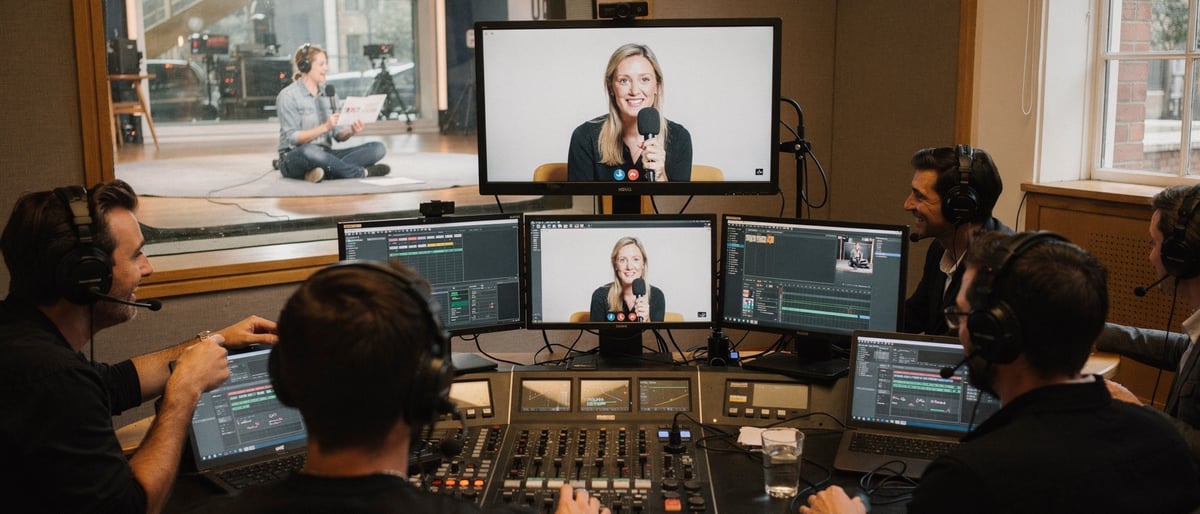
The brief called for a four-person roundtable: three guests physically in the London studio, one remote. By noon, the London guests were in the room. We ran camera and lighting checks for each seated position, confirmed audio routing on all four feeds, and calibrated the virtual studio environment so that the background depth and colour temperature read consistently across all three physical seats. The remote guest's camera angle was a fourth position, cut to the same frame ratio and lit to carry the same visual weight as the seats in the room.
A remote face joining from a laptop camera and a home bookshelf breaks the visual grammar, and the audience categorises that guest as a lesser participant.
A remote angle cut to the same frame ratio and lit to carry the same visual weight reads as a fourth seat in the room.
This is the element that most remote integrations skip, and where most of them fail. A remote face joining a panel from a laptop camera and a home bookshelf looks different from the rest of the production. It breaks the visual grammar of the piece. The audience registers it in the first few seconds and spends the remainder of the session categorising the remote guest as a lesser participant, whatever that guest is actually saying. The work of integrating a remote guest properly is almost entirely invisible: it is the work of making the visual language consistent before anyone speaks.
Three days before the session, we agreed the background with the guest. She photographed the space she would be sitting in: a home study with a dark, textured wall. We designed the London studio environment to complement that tone, so that the depth behind her would read naturally alongside the virtual backdrop our London guests were sitting in front of. When her feed was cut into the programme, the eye moved between seats without registering a change in production register. The visual grammar held.
Managing latency between London and Tokyo
On the day, the latency between London and Tokyo ran between 180 and 220 milliseconds. Not extreme, but enough to create a talk-over risk in live conversation if the host was not actively managing pace. We briefed the host in the pre-show run-through to use visual cues rather than audio gaps when handing to the Tokyo guest: a slight pause, a deliberate look to camera, then a verbal handover. That single adjustment removed every overlap risk from the ninety-minute session.
When the connection dropped
Eleven minutes before the panel started, the guest's connection dropped. She was back in thirty-eight seconds. I know the exact time because we had rehearsed what to do if it happened. The backup was a mobile hotspot she had tested with us during the technical run the previous afternoon. She knew to switch to it, and she did. The session went live without the audience knowing the connection had interrupted at all.
The contingency worked because it was documented. Not as a note in an email, but as a step in the pre-show brief that the guest had read and confirmed two days before. When the drop happened, she did not need to think about what to do. She executed the instruction she had already absorbed.
Preparation prevents failure, not technology
What prevents a remote integration from failing in front of an audience is almost never the technology. Routers and bandwidth are what they are. What prevents failure is the preparation that runs in the seventy-two hours before the session, and the procedural calm in the twenty minutes before it goes live. A crew that has managed this configuration before does not improvise when a connection drops. They execute the plan they built for that scenario.
The Tokyo guest was in our studio feed for ninety-one minutes. The audio was clean throughout. The programme editor's session log did not flag the remote join once. At wrap, she messaged to say she had not been anxious about the technical side because the briefing had given her a clear picture of what to expect and what to do if anything went wrong. That is what a well-run virtual studio in London produces for a remote guest: confidence in the session, not anxiety about the infrastructure behind it.
Treating remote integration as a last-minute accommodation produces the dropped call, the visible latency, and a programme that reads as two pieces cut together.
Building the remote position into a controlled production environment from the start absorbs the integration without the audience seeing the seams.
The organisations that avoid remote guests in live and recorded panel formats usually do so because they have experienced the failure mode: the dropped call, the visible latency, the production that reads as two pieces cut together. That failure mode is real. It exists in sessions that treat remote integration as a last-minute accommodation rather than a planned element of a controlled production environment.
Build the remote position into the brief from the start. Confirm technical requirements with the guest three days in advance, not thirty minutes before the session. Rehearse the contingency. Every variable that can be anticipated has already been solved by a studio that runs these sessions regularly. If you have a remote guest joining a London studio session and you are not sure what the technical briefing should cover, get in touch and we will send through the checklist we use.
Frequently asked questions
How far in advance should a remote guest's setup be confirmed?
Confirm technical requirements with the guest three days before the session, not thirty minutes before. The background, camera angle and contingency are all agreed and tested in advance.
What happens if the remote guest's connection drops mid-session?
A tested backup such as a mobile hotspot is documented as a step in the pre-show brief. In our Tokyo session the guest switched within thirty-eight seconds and the audience never knew.
How do you stop a remote guest looking like a lesser participant?
By matching the visual grammar before anyone speaks. The remote camera angle is cut to the same frame ratio and lit to carry the same visual weight as the seats in the studio.
Does latency make live remote panels risky?
Latency of 180 to 220 milliseconds is manageable when the host uses visual cues rather than audio gaps to hand over. That single adjustment removed every overlap risk from a ninety-minute session.
Why use a virtual studio rather than a standard remote call?
A controlled studio environment lets the remote feed read consistently against the studio backdrop, so the eye moves between seats without registering a change in production register.