
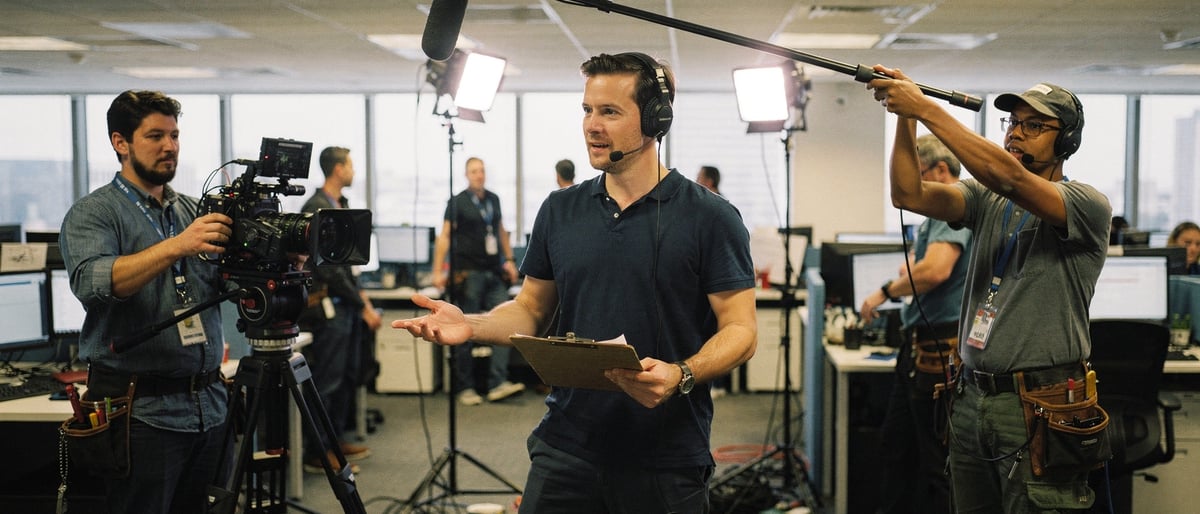
The talent arrived forty minutes late. Not the guest, not the presenter. The talent hired to operate the teleprompter.
We had a CFO on set, a camera operator who had driven from Bristol, and a client watching via Zoom from Frankfurt. The teleprompter operator sent a text from an Uber stuck somewhere near Waterloo. ETA unknown.
Most people on set looked at me. I looked at the producer.
She had already made three decisions before I had time to ask a question. She pulled a copy of the script from her bag, handed it to the presenter, said "let's treat it as autocue-free and make that the story", and was on the phone to the camera operator telling him to adjust his shot list to wider coverage so the presenter could move more freely. The Frankfurt client got a WhatsApp with a revised timeline. Done.
That is what a producer does. Not the admin version of the role. The real one.
The gap between the plan and the room
Call sheets, run orders, timings and kit lists, all confirmed before anyone sets foot in the building. A tidy version of the day on paper.
Live rooms have live variables. A guest who drifts from the brief, a client with a new message, a set that reads differently in daylight than in the render.
Every shoot has a plan. Call sheets, run orders, timings, kit lists. The plan exists before a single person sets foot in the building. What a producer manages is the gap between the plan and what the room actually contains on the day.
At our filming studios on the London Southbank, we see that gap in every production. Not because something always goes wrong, but because live rooms have live variables. A guest who rehearsed their lines in the car and is now slightly different from the brief. A client who has a new message they want included, passed to the producer thirty minutes before the shoot. A set that was loaded in last night and looks slightly different in daylight than it did in the render.
A good producer absorbs all of this before it reaches the talent or the client. They are the signal filter. The room stays calm because one person is managing the noise at the edges.
What the producer actually controls
People often assume the producer controls the budget, the brief, and the shooting schedule. Those are the obvious ones. The less visible list is longer.
They control the energy in the room. If a presenter is nervous, the producer has the relationship that settles them. If a client is hovering near the camera position, the producer is the one who finds them a better vantage point and turns a potential distraction into an engaged collaborator.
They control time. Not in the sense of watching a clock, but in the sense of knowing which elements of the day are genuinely fixed and which have give. The director I work with most often says the producer's job is to protect the take. Everything else is negotiable. The take is not.
They control information flow. Who knows what, when. A producer decides which pieces of context go to the director, which go to the client, and which are simply absorbed and managed without ever being surfaced. Most of the crises that do not happen on a shoot day are invisible precisely because a producer decided they did not need to be anyone else's problem.
The shoot that showed me the difference
A few years ago we ran a full-day testimonial shoot at our filming studio, with six contributors across three separate set-ups and a client attending in person for the first time. The brief had been confirmed two weeks before. One week before, the brief changed: two of the contributors were now covering something slightly different from the original, and the client had added a third set-up that was not in the original scope.
The director found out about this when he arrived on set.
The producer had known for four days. She had already adjusted the run order, confirmed revised release forms, briefed the makeup team on the updated timing, and pre-empted three questions the director would have asked by writing the answers in a note at the top of his call sheet.
The shoot ran eleven minutes behind. Given what had changed, that is a minor miracle. It happened because the producer treated the brief change as her problem to solve before it became anyone else's problem to manage.
Why this matters at the Southbank
Filming studios on the London Southbank attract productions that are time-pressured by default. The location brings a level of expectation, from clients, from contributors, from the content itself. You do not book a Southbank studio for a rough-and-ready internal communication. You book it because the output matters.
That context makes the producer's role sharper. There is less tolerance for a session that loses its rhythm. Less room for a client to feel the chaos behind the camera. The output needs to look and feel considered, even on the days when the room is anything but.
The Southbank environment also adds its own live variables. Deliveries, neighbouring productions, sound from the river, the ordinary churn of a working building. The producer is the person who accounts for all of that in the plan and adjusts in real time when the plan meets the day.
What to look for when you hire
The producers worth working with are the ones who ask more questions in pre-production than most clients expect. They want to know about the office politics around the brief. They want to know if the CFO has done camera interviews before. They want to know who is ultimately signing off the edit, and whether that person has strong opinions about on-camera style.
Those questions are not small talk. They are the raw material of the plan that will keep the shoot on track when the teleprompter operator is stuck in a Waterloo Uber.
When something changes at 9am on a shoot day, a weaker producer lets it grow, until the change reaches the talent, the client and the director as a crisis.
The great ones make the change smaller. They absorb it, adjust the run order and solve it before it becomes anyone else's problem to manage.
We work with a small group of producers we trust entirely. The selection criterion, if I had to name one, is this: when something changes at 9am on a shoot day, do they make it smaller or larger? The great ones make it smaller. Every time.
If you are planning a production at filming studios on the London Southbank and weighing up whether a producer is worth the budget, the question to ask is not what they cost. The question is what a lost afternoon costs. Then decide.
Frequently asked questions
What does a producer actually do on a shoot day?
They manage the gap between the plan and what the room actually contains. They control the energy in the room, the timing and the flow of information, absorbing problems before they reach the talent or the client.
Is a producer worth the budget for a single shoot?
The question is not what a producer costs, but what a lost afternoon costs. A good producer keeps a time-pressured shoot on track when something changes at short notice, which is when the budget pays for itself.
How is a good producer different from an average one?
When something changes at 9am on a shoot day, do they make it smaller or larger? The great ones make it smaller, every time, by solving the change before it becomes anyone else's problem.
What should I look for when hiring a producer?
Look for the ones who ask more questions in pre-production than you expect, about the office politics around the brief, whether contributors have done camera interviews before, and who is signing off the edit.
Why does the producer's role matter more at a Southbank studio?
Productions there are time-pressured by default and the output is expected to look considered. There is less tolerance for a session that loses its rhythm, so the producer's role becomes sharper.