
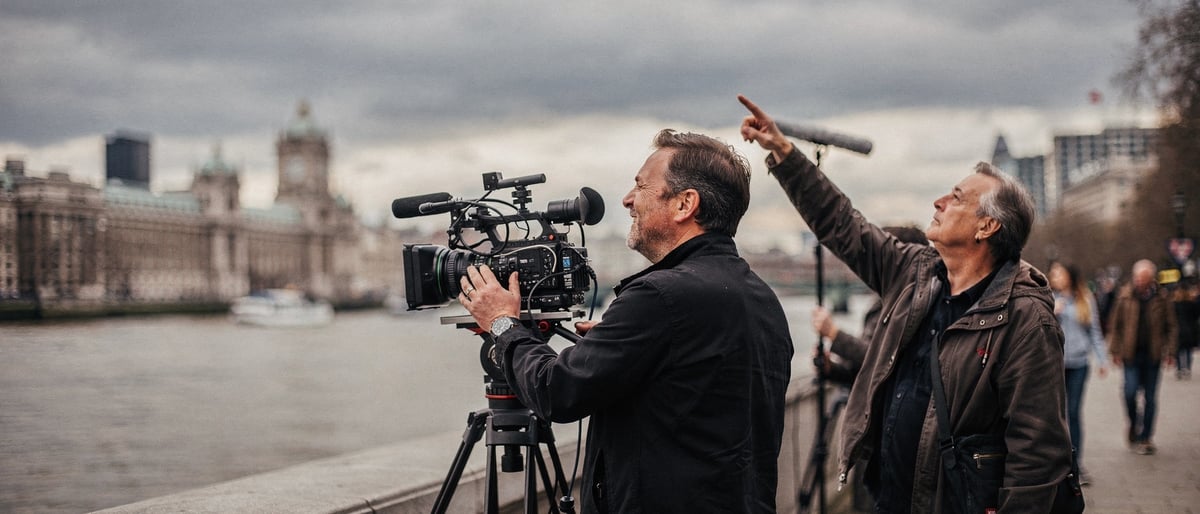
The first time we scheduled a Southbank exterior without checking the tide, we lost ninety minutes of usable light. Not to bad weather. The sky was clear. We had planned the shot list, confirmed the crew, briefed the client. What we hadn't checked was that the water level at low tide drops the river surface almost two metres below where it sits mid-morning. The skyline reflected in the Thames we had planned to put behind the interview chair simply wasn't there at 8am. It showed up, beautifully, at 10:47.
That is the kind of thing you learn once.
On any filming studios london southbank exterior now, we start with three variables before we look at the script or the shot list: the tide table, the sun angle, and the permit window. Get those three right first and everything else slots in. Get one wrong and you are booking a second day, which is the most expensive lesson a production team can learn.
What the river actually does to a shoot
The Thames on the Southbank behaves differently from what you see in the daytime photographs posted on production directories. At high tide, the walkway below the NFT narrows. Foot traffic moves closer to your kit. The reflected light off the water is softer and more diffused. At low tide, you have more space, less reflection, harder midday shadows on a south-facing subject. Neither is wrong, but each needs a different setup.
A shoot planned for golden hour but arriving at low tide will find a mudflat where the river glitter should be. We pull the tide table the week before and again the morning of. We look for the two-hour window around high tide that falls closest to the permitted call time. When those two things do not overlap, we push the call time.
This sounds basic. It gets skipped on a significant number of exterior productions we see come back for a second day.
Sun angle and the south-facing problem
The Southbank faces roughly south. In summer that is excellent news for early morning and late afternoon, and a slow problem through the middle of the day. Direct overhead sun on a south-facing subject gives you washed-out skin, hard eye-socket shadows, and a sky that blows out on most camera sensors.
We schedule around it. Morning calls for interview setups allow soft, raking light from the east that wraps a face properly. Calls from around 15:30 in summer shift the sun low enough from the southwest to be workable. The stretch from roughly 11:00 to 14:30 in late spring and summer is the one we avoid for anything with a person in frame.
The same sun angle that flatters a face in April will compromise a shot by June. We run solar angle projections when we book, not when we arrive.
The permit question
Most clients assume the Southbank is public space and that filming is free. Parts of it are, up to a point. Quiet handheld B-roll with a small crew often falls inside what the Southbank Centre and the local authority allow without prior notice. A tripod, a separate sound operator, and a branded client interview do not. That crosses into a permit requirement, and the specific zone on the permit matters more than most clients expect.
Filming facing the Tate Modern is governed differently from filming facing the National Theatre. We have had crew turned around mid-setup because the permit zone covered the wrong side of the walkway. Two minutes and two hundred metres, and we were outside the approved area.
We submit permit applications two weeks ahead when possible. The approval turnaround is not always predictable, and a late approval can leave you shooting in the wrong patch entirely. When a client comes to us with a date already fixed, the first thing we check is whether the permit window for their zone is still available. That check has prevented three reschedules in the past eighteen months.
The location advance
A location advance is not a courtesy visit. It is an hour spent walking the exact path from the vehicle drop point to the filming position, measuring the ambient noise profile at the scheduled call time, checking where the shade falls at noon, and identifying which power outlet on the walkway is live. Crews who skip the advance tend to invoice for problems on the day. Crews who do it invoice for the shoot.
The advance also confirms the physical reality of what you saw in photographs. A spot that looks wide and clear in a scout image taken on a quiet Tuesday morning at 9am looks different on a Friday at 11am with school groups, tourist guides, and two other production units already set up nearby. We have pulled four Southbank exteriors into our green-screen studio after an advance revealed that the location conditions had changed enough to affect delivery. The composited result looked identical to the exterior the client had originally briefed. The client delivered on time, on budget, without a second day.
Contingency is the product
The thing I say to clients about Southbank exterior work is that our job is not to film on a specific spot at a specific time. Our job is to get a clean, broadcast-quality result on the day agreed. Those are different promises.
Filming locked to one spot at one time. If the tide, light or permit zone turns against you on the day, the choice is a compromised shot or a second shoot day.
A matched green-screen composite background is built into the call sheet, so the interview moves indoors and the client still sees a clean London exterior delivered on time and on budget.
When we build the call sheet for an exterior at any filming studios london southbank location, we include a studio option. That is not a backup plan in the defeatist sense. It is the same logic a flight crew uses for fuel reserves: you plan it in, you hope not to need it, and you are glad it is there. The green-screen studio means we can move the interview indoors with a matched composite background and the client never sees a compromise in the final cut. What they see is a clean London exterior that looks exactly as planned.
The crews that plan for the result rather than the location are the ones who stop calling clients with bad news about reshoot days.
What to do before you book
Before you confirm a Southbank exterior, run four checks: pull the tide table for your date and identify the high-tide window; run a solar angle calculation for your proposed shoot hours; verify that your permit zone covers the actual position you intend to film from; and walk the location at the same time of day as your call time, at least one week before the shoot.
If any of those four checks produce a conflict, solve it before you confirm the crew. The conflict does not get smaller on the day.
If you want help running that advance on a Southbank location, talk to us before you lock the date. We know the territory, and we would rather spend that hour with you than spend the day managing a reschedule.
Frequently asked questions
Why does the tide matter for a Southbank shoot?
At low tide the river surface drops almost two metres and the skyline reflection in the Thames disappears. We pull the tide table to find the high-tide window closest to the call time, and push the call if they do not overlap.
When is the best time of day to film on the Southbank?
The Southbank faces roughly south, so morning calls give soft raking light from the east and calls from around 15:30 in summer work from the southwest. We avoid roughly 11:00 to 14:30 in late spring and summer for anything with a person in frame.
Do I need a permit to film on the Southbank?
Quiet handheld B-roll with a small crew often falls inside what is allowed without notice. A tripod, a separate sound operator and a branded client interview cross into a permit requirement, and the specific zone matters. We submit applications two weeks ahead where possible.
What is a location advance and why does it cost an hour?
It is an hour spent walking the path from the vehicle drop to the filming position, measuring ambient noise at the call time, checking where shade falls at noon and finding which power outlet is live. It confirms the real conditions before the day.
What happens if the weather or conditions turn on the day?
Every exterior call sheet includes a green-screen studio option with a matched composite background. The interview moves indoors, the final cut still looks like the briefed London exterior, and the client delivers on time without a second day.