
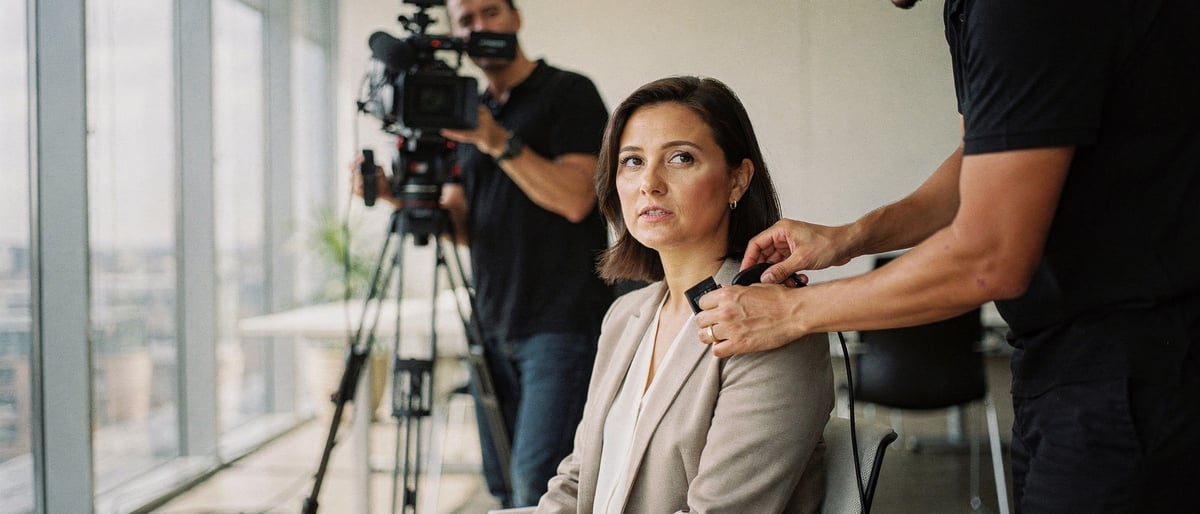
The brief was clear. One executive, one morning, one chance. The client's Chief Commercial Officer had agreed to a testimonial interview, which in practice meant a window of ninety minutes between two European flights. No second availability. No pickup day. Whatever we recorded that morning was what we were cutting with.
We have all had versions of that brief. The senior leader who will not do a second session. The external contributor who is flying in for one thing. The client whose budget covers one crew day but whose wishlist assumes the ability to come back.
The instinct, when you hear a brief like that, is to treat the pressure as something to manage on the day. That instinct is wrong. One-shot days are not managed on the day. They are managed in the four weeks before.
Where single-take failures actually start
Treat the pressure as something to manage on the day, reacting to each surprise as it lands inside the ninety-minute window.
Manage the one-shot day in the four weeks before, confirming every assumption in writing so nothing surfaces on the morning.
Most problems on a one-shot testimonial trace back to assumptions. Not decisions. Assumptions. The exec assumed a stylist was included. The producer assumed the client had briefed the exec on format. The client assumed the location had parking. Each assumption was small enough that nobody confirmed it in writing. Together they filled the ninety-minute window before a single usable take was in the bag.
We run what we call an assumptions audit at briefing stage. Not a checklist of things we will arrange. A list of things that have not yet been confirmed and that, if wrong on the day, would collapse the schedule. Then we confirm each one. In writing, with the person who is responsible for it, not the person who forwarded the email.
For a testimonial at filming studios london southbank or in our green-screen studio, the audit typically covers: the exec's confirmed window from the exec directly, not from the PA who confirmed it three weeks ago; whether they will work from a prompt or a scripted answer; who from the client side will be in the room and whether any of them plan to give direction; what the exec will wear and whether brand guidelines need sign-off; and what happens if the exec is delayed by more than thirty minutes.
That last point is the one clients sometimes push back on as overly cautious. It is the point that has saved two testimonial shoots in the last eighteen months.
What the pre-shoot brief is actually for
A pre-shoot brief for a senior executive is not a run-through of the interview questions. When you run through the questions, you get a performance on the day instead of a conversation. The brief serves a different purpose.
What it does is remove the unknowns from the room before the exec walks in. They understand where the camera is, where the interviewer sits, roughly how long they will be on camera, and how the session will run. That is enough. Subjects who understand the physical setup give you usable material faster than polished subjects who are still adjusting to the room on take one.
We send a single page to the exec three days before. Not the full production schedule. One page: where to be, what to bring, what to expect when they arrive, and two sentences on how the conversation will work. That brief goes directly to the exec, not through the client's communications team. The communications team edits out what they think the exec does not need to know. Those things are almost always the ones the exec needed to know.
Camera and sound redundancy
On a one-shot day, we run two cameras as standard. Not primarily because we intend to cut between them, though that option has value in the edit. Because one camera failing on a single-take brief with a non-repeatable subject is not a production problem. It is a commercial problem for the client that we will not be able to fix.
The second camera body costs a fraction of a day rate. It costs nothing compared to the conversation where you explain that the executive's testimonial does not exist because a sensor failed.
Sound follows the same logic. Our standard on testimonial work is a radio lapel as primary, a directional hypercardioid as secondary. If the lapel clips against fabric or picks up the exec tapping the desk, the directional track is clean. If both tracks have a problem, we stop and fix it before continuing. We do not push through a sound issue on the assumption that post-production will salvage it. Post-production cannot salvage what was not recorded cleanly, and on a one-shot brief there is no second take to cover the problem.
The studio option for high-stakes testimonials
A Southbank location exterior brings river noise, permit timing, shifting light and uncontrolled foot traffic into a non-repeatable shoot.
The green-screen studio removes those variables and composites the London background in, so footage is usable from take one.
For subjects who are not repeatable, we often recommend our green-screen studio over a location exterior, even when the brief includes a specific Southbank backdrop. The studio removes the variables that can derail a location exterior: no ambient noise from the river, no permit timing constraint, no light shifting through a two-hour window, no uncontrolled foot traffic in the background between takes.
When the client wants the London feel, we composite the relevant background in the mix. The result is a clean interview against a consistent backdrop that matches the location the brief described. The exec cannot tell the difference. The audience cannot tell the difference. The footage is usable from take one because the conditions were controlled from the start.
This is the conversation we have on every one-shot brief that mentions filming studios london southbank as the setting. A Southbank location is a visual decision. The studio is an operational one. Both produce the same frame. Only one of them removes the chance of a second day that was never in the budget.
What happens after the executive stands up
The first thing we do when a one-shot session ends is confirm with the director of photography that both cards are safe and both sound tracks are clean. Before the client has said anything about the session. Before anyone has offered a coffee. Both cards safe, both tracks clean. Then we carry on.
That confirmation is not bureaucratic. It is the moment that tells us whether the work is done or whether we have a problem to surface now, while the exec is still in the building, rather than at edit review three days later.
De-risking a one-shot testimonial day is not a philosophy. It is a sequence: the assumptions audit at brief stage, the exec pre-shoot brief sent directly, the redundant camera and sound setup, the studio fallback confirmed before the call sheet is issued. Each step removes a specific failure mode. When they are all in place, the day itself tends to feel straightforward.
That is, precisely, the point.
If you've got a one-shot brief coming up, talk to us before the pre-production window closes. We'll run the assumptions audit together and tell you honestly what can go wrong and how we've built around it.
Frequently asked questions
What does de-risking a one-shot testimonial day actually involve?
It is a sequence, not a philosophy: an assumptions audit at brief stage, a pre-shoot brief sent directly to the executive, redundant camera and sound, and a studio fallback confirmed before the call sheet is issued.
Why run two cameras for a single testimonial interview?
With a non-repeatable subject, one camera failing is a commercial problem the client cannot fix. A second body costs a fraction of a day rate, far less than a testimonial that does not exist because a sensor failed.
Should a high-stakes testimonial be filmed on location or in a studio?
For subjects who are not repeatable, we often recommend the green-screen studio over a Southbank location exterior. The studio controls noise, light and background, and we composite the London backdrop in so the frame still matches the brief.
What is the pre-shoot brief for if not the interview questions?
It removes the unknowns from the room before the executive walks in: where the camera is, where the interviewer sits, how long they will be on camera and how the session runs. It goes directly to the executive, not through the communications team.
What is the first thing you check when a one-shot session ends?
We confirm with the director of photography that both cards are safe and both sound tracks are clean, before anyone offers a coffee. That tells us whether the work is done while the executive is still in the building.