
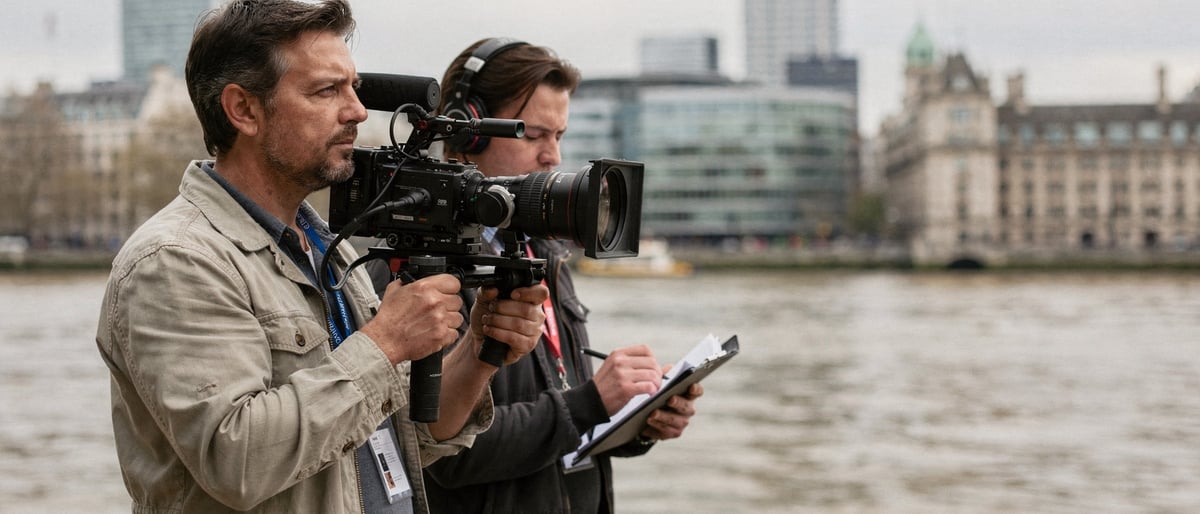
We had the river behind us, St Paul's across the water, the kind of shot that makes a client nod before you've said anything. By eleven we'd recorded almost nothing we could use.
The light had moved. The wind off the Thames was loud enough to ruin the audio on every take. A school group came through at the exact moment we found a clean thirty seconds. Our presenter was cold, distracted, and quietly wondering why we hadn't just booked a room. I'd chosen the Southbank because it looked right in my head. I hadn't chosen it as a production decision, and the morning made me pay for the difference.
A backdrop is a decision wearing a disguise
I'd got one thing badly wrong, and it took losing a morning to see it. I'd treated the location as scenery. Something pretty behind the message. Scenery is passive. You point the camera at it and it sits there being nice.
A location isn't passive. It's an active part of the shoot that decides your light, your sound, your control, your schedule, and how much of your budget goes on managing all four. The river view I wanted came bundled with everything else the river does. Wind. Crowds. A sun that doesn't wait for you. Reflections off water that change minute to minute. None of that was a surprise once I thought about it. The mistake was not thinking about it until we were standing in it with a camera running.
A location decides your light, your sound, your control and your schedule. It is never just the thing behind the message.
What the Southbank actually gives you
I'm not going to tell you to avoid it. The footage we eventually got, on the second attempt, was better than anything a studio could have produced for that particular film. It placed the company in London in a way no painted backdrop ever convinces anyone of. The filming studios on the Southbank that crews rely on exist alongside the location itself rather than instead of it, because the river earns its place when the film is about being here. Open. Part of the city. It says something a controlled room cannot, and audiences read it instantly, without being told.
The cost of that is control. You trade a predictable environment for a real one. The question is never whether the Southbank looks good. It always looks good. The question is whether what it gives you is worth what it takes, for this specific film, on this specific day, with this specific message.
The reframe that fixed how I plan now
So I stopped choosing locations by how they photograph. Now the first question on any shoot is what the film has to prove, and the place has to earn its way in against that.
A recruitment film that needs to feel like the actual working day belongs somewhere real, and the cost of control is worth paying. A leadership message that needs every word landing cleanly, no competing noise, full command of light and sound, belongs in a studio, and the river would actively work against it. Same company, same week, two films, two correct answers. The location follows the message. It doesn't lead it, and it doesn't get chosen because it photographs well.
Booked the Southbank because it looked right, treated the river as a backdrop, and lost a morning to wind, crowds and moving light.
Chose the location after deciding what the film needed to be true, planned the day around the river's constraints, and used the view because the message earned it.
Before: Booked the Southbank because it looked right, treated the river as a backdrop, and lost a morning to wind, crowds and moving light.
After: Chose the location after deciding what the film needed to be true, planned the day around the river's constraints, and used the view because the message earned it.
How the second shoot was planned
On the second shoot we went out early, before the crowds and while the light was kind. We had a fallback indoor space booked for the same day in case the wind didn't cooperate, which cost something but cost less than another wasted morning. We accepted that the river meant a windjammer on every mic and a tighter shooting window. None of that was clever. It was the planning I should have done before treating a working location like a stock photo.
I stopped asking where this would look best. I started asking what this film needs to be true. The location follows that answer.
What this means before you book anything
The Southbank is one of the best filming locations in London and it will punish you for assuming it's easy. So will most real places. The decision worth making before you fall in love with a view is the boring one. What does this film need to do, and does this location help it do that or just look impressive while it gets in the way.
Most production problems don't show up as disasters. They show up as a morning that didn't yield, a presenter who lost confidence outdoors, a clip that's almost right but the audio gives away that nobody planned for the river. By the time you see those, the day is gone and the budget went with it.
If you've got a film in mind and a location in your head that you haven't pressure-tested yet, that's the conversation worth having before you commit a crew to it. Tell us what the film needs to do and we'll tell you whether the Southbank earns its place or quietly works against you. It's a short conversation, and it costs a lot less than the morning I lost to a view I never pressure-tested.
Frequently asked questions
Is the Southbank a good place to film in London?
Yes, when the film is about being open and part of the city. It places a company in London in a way no studio backdrop convinces anyone of, but only if the message earns the view.
Why does location count as a production decision and not just a backdrop?
A location decides your light, your sound, your control and your schedule. It is an active part of the shoot, not passive scenery behind the message.
When should I choose a studio over an outdoor location?
When every word has to land cleanly with no competing noise and full command of light and sound. A leadership message belongs in a studio where the river would actively work against it.
What are the main risks of filming outdoors on the Southbank?
Wind off the Thames ruining audio, crowds and school groups interrupting takes, and light that moves through the morning. You trade a predictable environment for a real one.
How do you plan a shoot around the river's constraints?
Go out early before the crowds while the light is kind, book a fallback indoor space for the same day, and accept a tighter shooting window with wind protection on every mic.