

The client's marketing director sent me the numbers three months after the series launched. She had run the same episode in two formats: video on YouTube and LinkedIn, audio on Spotify and Apple. Same content, same guest, same publishing window, same promotional spend.
The video version had three times the completion rate. The audio version had six hundred more downloads in the first week.
She wanted to know which one had worked.
Both had. That is not the interesting question. The interesting question is why the video format outperformed on every metric that actually moves a pipeline.
What completion rate tells you that downloads do not
A download triggers when a device syncs at two in the morning. The number is large and grows steadily, but says almost nothing about whether anyone listened.
A 60% completion rate on a thirty-minute episode means someone watched for eighteen minutes. It is harder to flatter and shows who actually heard the argument.
Downloads are a vanity metric with good PR. The number is large, grows steadily, and means almost nothing about whether anyone paid attention. A podcast download triggers the moment someone's device syncs with a platform at two in the morning. Whether they listened is a separate question entirely.
Completion rate is harder to flatter. On YouTube, a 60% completion rate on a thirty-minute episode means someone watched for eighteen minutes. On a corporate video London brief aimed at B2B buyers, that is the difference between a viewer who heard the argument and a viewer who heard the introduction.
The marketing director's audio version had a 23% completion rate. The video version had 71%. The audience that found the video format was smaller, but they stayed. They heard the whole thing. They were seventeen times more likely to share the episode.
Sharing is not a vanity metric either. In a B2B context, sharing means a buyer forwarding a video to a colleague with a note. That is qualification happening outside the funnel, before anyone has spoken to sales.
What makes someone watch rather than listen
Convenience is not the only factor in media choice. The assumption built into the client's distribution plan was that audio is easier to consume on the move, so audio would reach more people. The first half of that is true. The second half is not.
The audience choosing to watch a video podcast is making a commitment. They are sitting down, opening a screen, allocating time. That audience is not larger than the audio audience, but it is qualitatively different. A higher proportion of video podcast viewers are in a deliberate, attentive state. They chose video knowing it costs more attention than audio. That self-selection produces the completion numbers.
The visual element does something else. It gives the viewer something to read beyond the words: specifically, the person. How a guest responds to a question before they answer it. Where they look when they are thinking. Whether they are choosing words carefully or talking from habit. None of this is available in audio. In a thirty-minute B2B conversation about a technical or strategic topic, those signals are data. Buyers use them to assess whether the person speaking actually knows what they are talking about.
This is not a design insight. It is a behavioural one. The production implication is that a video podcast needs to be watchable, not just audible. The frame needs to hold attention, not only capture it.
Why the production setup matters more than people expect
Recording the planned audio version and adding a camera leaves the viewer watching a podcast in a spare bedroom or a company conference room.
In a virtual studio the background is chosen, not inherited. Intentional context signals seriousness and tells the viewer the content is worth the attention cost.
The client's first instinct was to record the audio version they had already planned and add a camera. We pushed back.
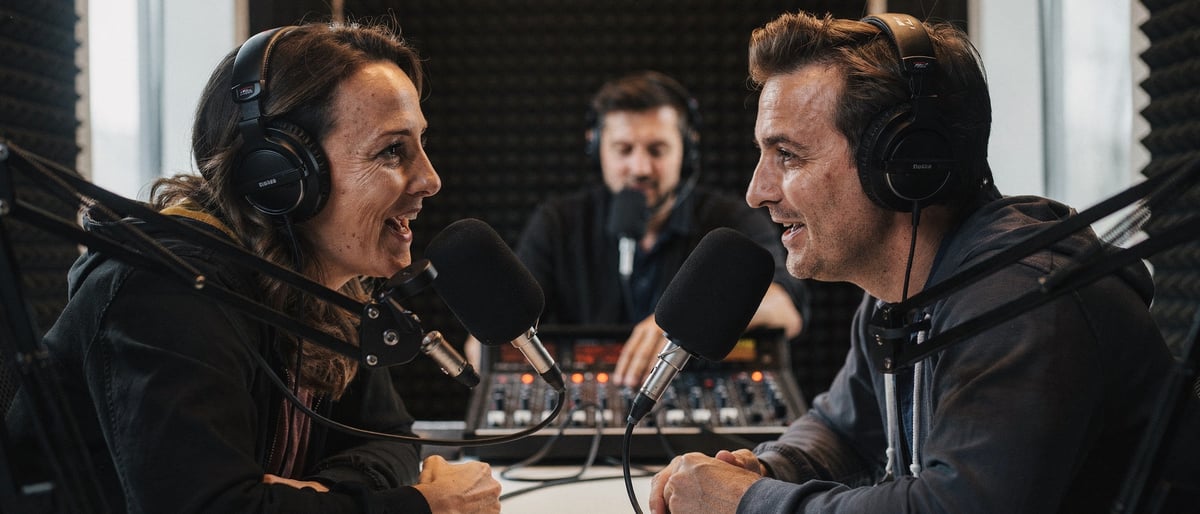
A well-built video podcast set is designed for two things: the visual dynamic between the two people on screen, and the background environment that tells the viewer something about the context of the conversation. In a virtual studio, that background is chosen, not inherited. The visual context of the conversation is intentional, not accidental.
For a corporate audience, intentional context signals seriousness. The viewer is not watching someone record a podcast in a spare bedroom or a company conference room. They are watching a produced programme. That distinction sounds superficial. It is not. It is the fastest available signal that the content is worth the attention cost.
The marketing director's video series ran twelve episodes. By episode six, they had inbound enquiries from two companies that had never engaged with their content before. Both named specific episodes. One named a specific moment in an interview: a point made at the twenty-two-minute mark of a thirty-four-minute episode.
That viewer had watched for thirty-four minutes, retained a specific detail, and converted on the back of it. That is not a download metric. It is a pipeline metric.
The distribution question starts from the wrong place
Most discussions about video versus audio start with the platform. Where is the audience? Which format does the algorithm favour? Those are real questions with real answers, and they matter for distribution planning.
The more important question comes earlier: what do you need this content to do?
If the answer is awareness at scale, audio is efficient. If the answer is building the kind of trust that moves a six-month sales cycle, the completion rate and share metrics from the video format are a better predictor of outcome than the download number from the audio cut.
The client knew this in retrospect. They should have known it before the first episode, which is why we now raise it in every brief that includes episodic interview content. The audio version reached more people. The video version reached fewer people for longer, and those people took action.
In a B2B context, that is not a close call.
[Talk to us about your next series and we'll walk you through the setup options before you commit to a format.]
Frequently asked questions
Is a video podcast worth the extra production cost over audio only?
It depends on the job. For awareness at scale, audio is efficient. For building the trust that moves a long B2B sales cycle, the video format's completion and share metrics are a better predictor of outcome.
Why does completion rate matter more than download numbers?
Downloads can fire when a device syncs overnight, so they say little about attention. Completion rate shows how much of the episode someone actually watched, which is what moves a pipeline.
Does video really reach fewer people than audio?
Often yes. The audio version typically reaches more people, but the video audience is smaller, more deliberate and stays for longer, and those viewers are far more likely to share and to act.
Why does the production setup matter so much for a video podcast?
A video podcast has to be watchable, not just audible. A built set controls the visual dynamic between the two people and a chosen background, which signals a produced programme rather than a recording in a spare room.
What should I decide before choosing video or audio?
Start with what you need the content to do, not the platform. The answer to that question tells you whether reach or depth of attention is the metric that matters.