
I used to hate watching my own footage.
Not because I thought I was particularly bad on camera, but because what I saw never matched what I thought I had given the director. I would leave a shoot feeling like I had said something worth saying, and then watch the playback and see a person who looked like they were reading from a mental list. The delivery was technically fine. The eyes were wrong.
For a while I put this down to being the CEO rather than the talent. My job was to run the company, not to be the face of it. We could film other people. I could stay behind the viewfinder.
When a client refused
That position lasted until a client called to say her CEO had refused to be on camera.
She was a founder. An articulate and compelling person who gave talks at industry events and held rooms well. She had watched a film we had made for a different client, seen how composed the speakers looked, and decided that composure was a quality she did not have. So she had taken herself out of the film entirely.
I went back to my own footage and started thinking about it differently.
What camera confidence actually is
The people who look natural on camera are not generally people who feel relaxed. They are people who have been directed in a specific way that releases the tension they already have.
You ask the person to relax their shoulders and speak slower. The effort of control is visible, so the footage reads as stiff on screen.
You ask a real question they know the answer to and let them talk. You can see it in the eyes, the person is thinking in real time.
There is a version of directing that focuses on confidence: relax your shoulders, look into the lens, speak a little slower. It produces presentable footage and misses the point. The presenter appears controlled, which reads on screen as stiff, because the effort of control is visible.
There is another version of directing that focuses on removing the frame. You stop asking the person to perform and start asking them to have a conversation. You put another person behind the camera and ask a question they actually know the answer to, not a scripted question but a real one. You let them interrupt themselves. You let them lose their thread and find it again. You stop the take when they start reciting and restart it when they start talking.
The second kind of footage is different. You can see it in the eyes. The person is thinking in real time, not retrieving. That is what camera confidence looks like. It is not absence of nerves. It is the director's job to create it, not the presenter's job to arrive with it.
What we told the founder
The client's CEO had imagined a scenario where she would be expected to perform a script and the camera would record every deviation from it. That is a reasonable fear. It is also not how a good shoot runs.
A scenario where she performs a fixed script and the camera records every deviation from it. A reasonable fear, but not how a good shoot runs.
Briefed on one thought, not a script, and asked to talk around it in her own words across multiple takes, with the weaker takes left out of the cut.
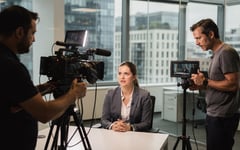
I told her what we actually do on a corporate video london shoot. We brief speakers in advance, but not on a script: on the one thought we want the viewer to leave with, and we ask them to talk around it in their own words. We shoot multiple takes, not because the first one is always wrong, but because the third take, when the speaker has stopped worrying about the shape of the sentence and started focusing on the idea, is almost always the best one. We cut between takes. We do not run what did not work.
She agreed to a single shoot day on one condition: she could see the playback in the room and pull any take she was uncomfortable with.
We did not pull a single take. By the third attempt at each section, she was speaking the way she spoke at the events she enjoyed giving: fast in places, slow in others, occasionally changing direction mid-sentence because a better version of the thought had arrived. That footage looked like her. She said so herself when she watched it back.
The footage that does not get used
There is a version of this that does not resolve cleanly on the day, and it is worth being honest about.
Some people have a specific self-consciousness in front of a lens that directing alone cannot resolve in one session. Not because they are bad speakers, but because the awareness of being filmed creates a loop the production process has to work around. The fix for this is usually not a different director or more takes: it is a different format.
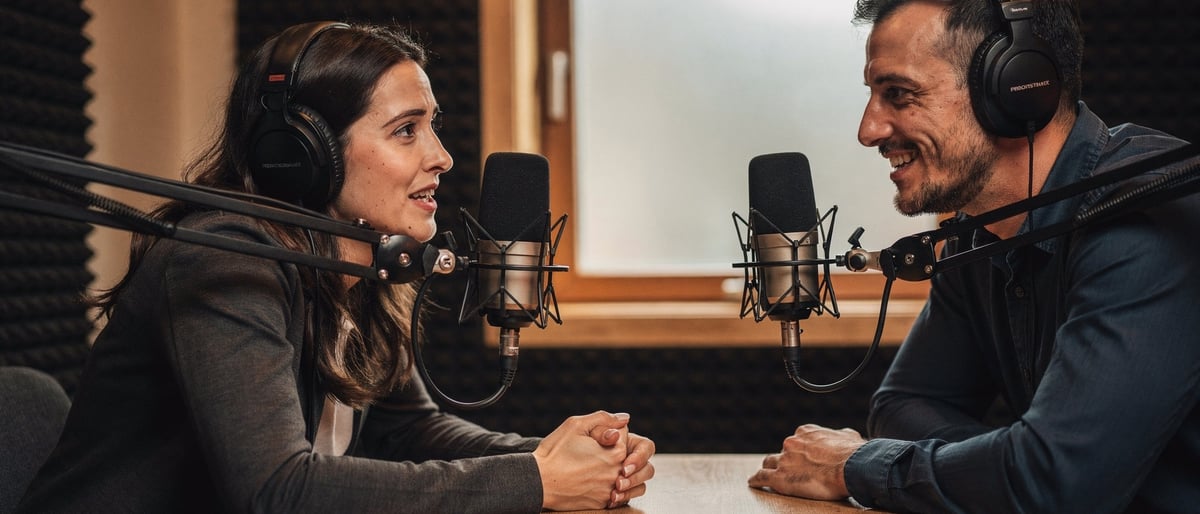
A conversation between two people, where neither is speaking directly to camera, removes the lens from the frame of attention. A walk-and-talk, where the speaker's mind is partly occupied with moving, produces footage that looks more inhabited than a static piece-to-camera. A structured interview, where the questions come from someone the speaker trusts, produces better material than any brief asking for "natural and authentic" ever does.
We work through the options before the shoot. Most clients arrive expecting to be evaluated on how well they can hold a pose in front of a lens. Most of them leave having made footage they did not expect to be comfortable with.
What the camera actually sees
The founder made a second film with us eighteen months later. She asked to be in it.
That is the shift that happens when someone discovers that camera confidence is not a personal trait but a production condition. The lens picks up what the speaker is actually thinking about. If they are thinking about whether they look credible, that is what you see. If they are thinking about the person they want to help, that is what you see instead.
We cannot make anyone good on camera in a single day. We can make the conditions under which most people become, for a morning or an afternoon, the version of themselves they are when they are talking about something they actually know.
That is most of the job. The camera does the rest.
If you or your team are nervous about a shoot, talk to us before you book the day.
Frequently asked questions
What if I am nervous about being on camera
Camera confidence is a production condition, not a personal trait. A good director creates it on the day by removing the pressure to perform, so you do not need to arrive with it.
Will I have to perform a script
No. We brief speakers on the one thought we want the viewer to leave with, then ask them to talk around it in their own words. We shoot multiple takes and cut between them.
Can I pull a take I am not happy with
Yes. You can watch the playback in the room and pull any take you are uncomfortable with. Only the footage that works gets used.
What if directing alone does not settle my nerves
The fix is usually a different format rather than more takes. A two-person conversation, a walk-and-talk, or a structured interview removes the lens from your attention and produces more natural footage.
Why do you shoot more than one take
The third take is almost always the best one. By then the speaker has stopped worrying about the shape of the sentence and started focusing on the idea.