
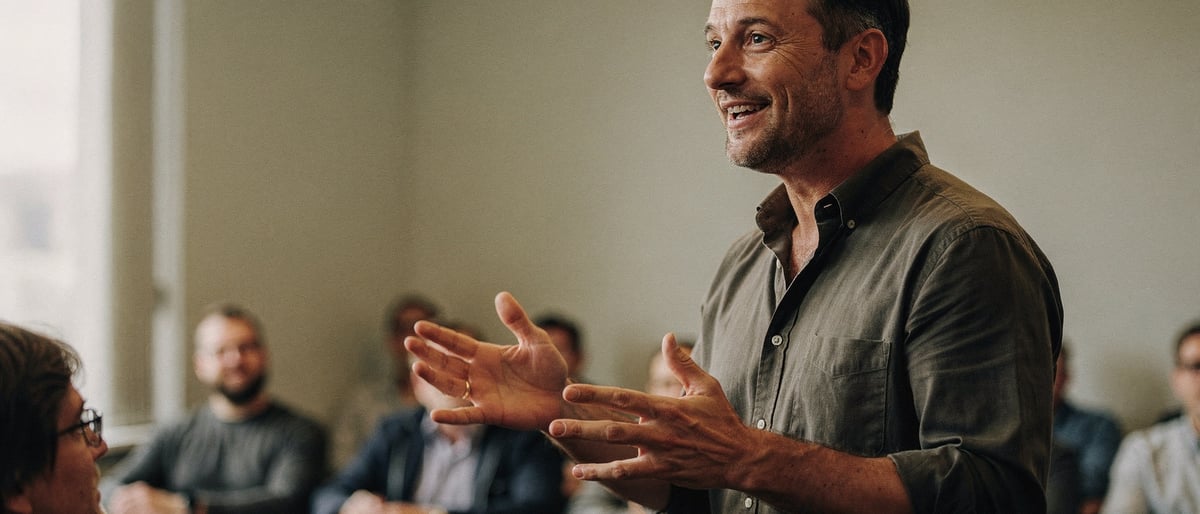
Scripts solve the problem of forgetting what to say and create the problem of sounding like you are reading. The audience notices even when they cannot say why. Three anchors replace a script better than memorisation does: the opening moment, the turn, and the close.
I watched the recording of a conference talk I gave four years ago a few months back. I'd been meaning to revisit it. Someone had mentioned it recently as an example of work I'd done, and I wanted to see how it held up.
About forty seconds in, I started wincing.
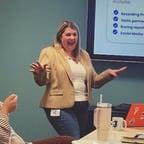
I had delivered that talk from a script. Colour-coded. Thoroughly rehearsed. Every pause timed, every transition marked. Afterwards, someone said I was "very polished." Standing in the green room, I'd taken that as a compliment. Watching the recording, I understood it differently. My eyes went to the notes every eleven seconds. The sentences came out in the precise rhythm they'd been written in. The moments where I'd planned emphasis were visible as exactly that: planned.
Polished meant: she sounds like she's reading it.
The argument against scripts
Marcus Sheridan and Tyler Lessard make a point in The Visual Sale that took me longer to accept than it should have. Scripts destroy the one quality that makes video and stage presentations worth experiencing: the sense that a real person is present, thinking in real time, talking to you rather than at you.
Production value matters up to a point. Authenticity matters past that point. An audience watching a polished, scripted presentation gets a performance. An audience watching someone who is present, responsive, and actually thinking gets a conversation. The distinction is perceptible even on screens, even without being able to articulate why.
A salesperson on a discovery call doesn't use a script. They have knowledge, preparation, a clear sense of where they want the conversation to go, and the capacity to respond to what actually happens in the room. A presentation is the same conversation at larger scale. The preparation doesn't disappear. The script does.
A script gives you control over every word and no control over whether anyone believes you.
The other thing the recording showed me was that I had memorised sentences rather than ideas. When I mis-started a phrase, I didn't recover with the thought in different words. I went back to the written sentence. The audience wouldn't have known. But I did, and the recovery cost me presence for the next thirty seconds while I found my place.
The 3-Second Smile
The most practical thing I picked up from The Visual Sale is small enough that it sounds trivial. Before pressing record, or before walking on stage, or before the camera goes live: start smiling three seconds before the moment of entry.
The three seconds matter because a smile that arrives with the moment reads as switched-on, performed, a social reflex. A smile that's already been running for three seconds when the audience first sees you reads as warmth. The difference is barely measurable in clock time. The difference in how the audience receives you is significant.
What the three seconds also do is displace nerves. The brain can't smile and catastrophise simultaneously with equal intensity. The act of smiling before the moment rather than at the moment moves you from braced-for-impact to present-and-open. That shift is visible, even on camera, even if nobody can point to what changed.
I use this before every talk now. Before every camera. Before every presentation that matters. It costs nothing and it changes the first impression in a way that the opening sentence alone cannot.
What replaced the script
Dropping the script didn't mean dropping preparation. It meant changing what I prepared.
Three anchors replace everything the script was doing. The opening moment: the specific story, image, or question that opens the talk. Not the introduction. Not the context-setting. The first moment of contact with the audience. This I know precisely, because first impressions compound. The opening moment sets the tone for everything that follows and needs to land.
The turn: the single point where the talk shifts. The reframe, the reveal, the pivot from problem to possibility. This I know precisely, because it's the reason the talk exists. If the audience takes away one thing, this is it. Getting there can happen by multiple routes. The turn itself doesn't move.
The close: the last thing the audience hears. Not the summary, not the call to action, but the final sentence or image. Endings are disproportionately memorable. The last impression follows people out of the room in a way that material from the middle rarely does. I write the close before I write anything else.
Full written script, memorised and rehearsed, delivered word-for-word, timed to the second.
Three anchors: the opening moment, the turn, the close. Everything between them, live.
Everything between the three anchors is prepared in terms of substance, not language. I know what points need to land. I know the examples I'll use. I know which questions from the audience are likely and what I think about them. I don't know which words I'll use to say any of it. That happens in the room, with the actual audience, in response to what's actually happening.
What the audience notices
The audience doesn't notice what you didn't say. They don't know the paragraph you cut at the last moment, the statistic you forgot, the transition you'd planned that didn't happen. They notice whether the person in front of them is present.
Present means: they're looking at us rather than at their notes. They're responding to the energy in the room. If something lands unexpectedly well, they stay with it. If something isn't landing, they adjust. They're thinking while they're talking, not recalling while they're talking.
The audience doesn't notice what you didn't say. They notice that you're not really there.
The recording four years ago showed me someone who had done a great deal of work and was not really there. The preparation had consumed the presence. I was delivering a document rather than a conversation.
The question I asked myself watching it back: would I trust this person with something that mattered? The version of me on screen was polished and correct. She wasn't someone I'd have wanted advice from. She was performing a role she'd rehearsed rather than thinking out loud about something she knew.
That's the thing a script costs. Not the words. The thinking.