
I once sat in a creative review where a marketing director dismissed a virtual studio option in under two minutes. She cited a branded video her company had produced seven years earlier: a presenter standing in front of a shaky composite city skyline. Her words were that it looked like a weather forecast. She moved on.
Her team spent the next three months sourcing a London office building that matched her brief. They paid a day rate that would have covered a full week of studio time, fought the building's facilities team over power access, and shot in a room that looked exactly like every other glass-and-steel corporate interior produced in that part of the city.
The video was adequate. Nobody mentioned weather forecasts.
The most expensive misconception
The green-screen objection is the most expensive single misconception in corporate video production. It is not rooted in what a modern green-screen studio delivers. It is rooted in a memory of what compositing looked like in 2017.
How green screen grew up
A presenter in front of a shaky composite skyline that read as constructed, the kind of result that looked like a weather forecast a decade ago.
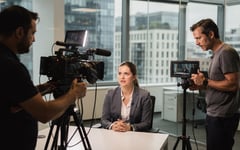
A subject lit to match a virtual space, edges holding in close-up, colour wrapping correctly, reading as though they belong to a real environment.
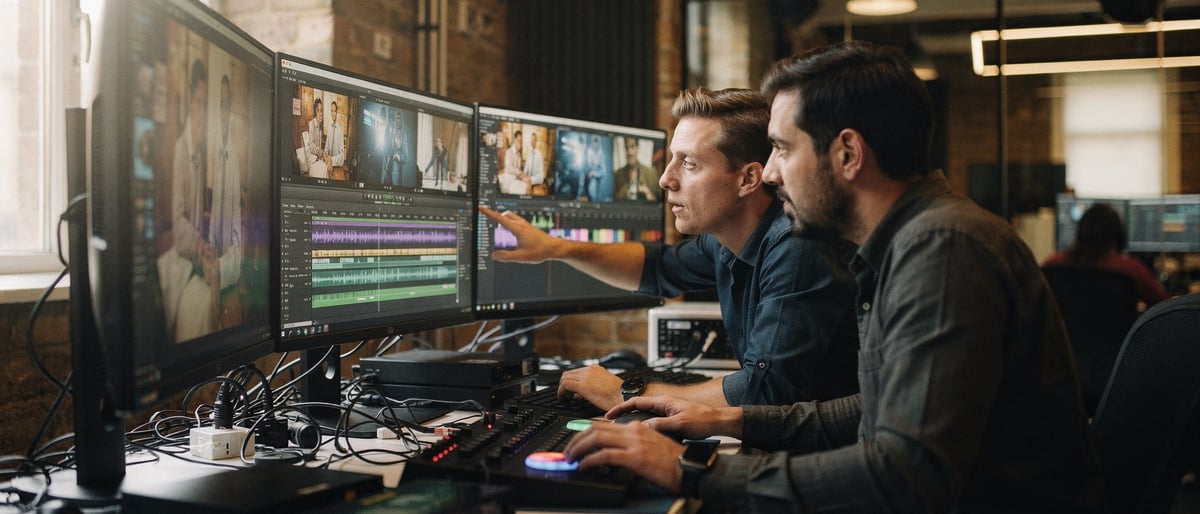
The shift happened gradually and without much announcement. Green-screen production grew up. Sensor resolution improved, compositing tools became faster, and the craft of studio lighting inside controlled environments developed to a point where the output stopped looking constructed. The virtual set the camera sees is designed, lit, and graded to read as a real environment. Edge work holds under focal lengths that would have broken the illusion a decade earlier. Colour temperature wraps correctly. The composite holds in close-up. A subject lit to match a virtual space reads as though they belong to it. Experienced viewers do not flag it. Most are not looking.
Two things follow. Quality: the output reads as considered, not constructed, which is the point. An audience watching a well-produced virtual studio film does not think about how it was made. Cost: a well-run virtual studio day often costs less in total than a location day that included a full compositing budget. That saving compounds across a production week.
The marketing director who rejected the virtual studio on a seven-year reference had never been shown the current product. Her team had not shown her because they shared the assumption. Her agency had not corrected it because location shoots were profitable and there was no particular incentive to challenge the premise.
This pattern is not unusual. I see it in creative briefings, in procurement conversations, in RFPs carrying a standing clause against virtual backgrounds, inherited from a pandemic-era video call that nobody in the room wants to revisit. Each of those clauses is protecting a category of expenditure that no longer needs protecting.
What makes this worth examining carefully is the asymmetry. A brand that updates its understanding of virtual studios in London can access schedule control, budget clarity, and set flexibility that location work cannot match at equivalent cost. The brand that does not update its understanding keeps paying location rates for problems that do not need to exist.
Where the budget actually goes
A location day costs what the quote says, plus contingency, plus overtime, plus recce days, travel and the reshoot premium when the building introduces a problem the recce missed.
A virtual studio day costs a known rate on a predictable schedule, with the variables controlled and no building introducing costs that never appeared as line items.
To be concrete about the gap: a virtual studio day costs a known rate on a predictable schedule. A location day costs what the quote says, plus the contingency, plus the overtime, plus whatever the building introduces that the recce did not catch. One of those variables is controlled. The other is not, and the history of corporate production is full of examples where the uncontrolled variable is the one that defines the final invoice.
A location booking also carries costs that rarely appear as line items in the initial quote: recce days, location management fees, crew travel, the overtime that location shoots generate at a rate studio work almost never does, and the reshoot premium when a day goes wrong. Aggregate these honestly across a production week and the gap with a studio equivalent is usually thirty per cent or more. That is not a rounding error. It is a budget line that simply disappeared into the framing of the initial comparison.
The objection disappears in the room
The objection the marketing director raised was framed as a quality concern. The subtext was about trust: could a studio deliver the environmental authority she needed the room to carry? That is a legitimate question. It has a straightforward answer. Bring her in to see one. The gap between the mental image of green screen and the reality of a well-equipped London studio closes the moment someone is standing in it.
In every case I can recall, it closes before the recce ends.
Why brands fall behind
The brands falling behind here are not making creative mistakes. They are making decisions on a reference point that lapsed several years ago. Their competitors refreshed their understanding of the available options. The gap in production efficiency and budget allocation is widening as a result. The deals they win will not be the ones where they sold the gain most persuasively. They will be the ones where they made doing nothing feel more expensive than acting.
Ask for a studio recce before your next brief locks. The objection disappears in the room.
Frequently asked questions
Does a virtual studio still look like an obvious green-screen composite?
No. The virtual set the camera sees is designed, lit and graded to read as a real environment. Edge work holds under focal lengths that would have broken the illusion a decade ago, and the composite holds in close-up.
Is a virtual studio day actually cheaper than a location shoot?
Usually, yes. A well-run virtual studio day often costs less in total than a location day that included a full compositing budget, and the saving compounds across a production week.
What hidden costs does a location shoot carry?
Recce days, location management fees, crew travel, the overtime location shoots generate, and the reshoot premium when a day goes wrong. Aggregated honestly, the gap with a studio equivalent is usually thirty per cent or more.
Why do so many briefs still rule out virtual backgrounds?
Many RFPs carry a standing clause against virtual backgrounds inherited from a pandemic-era video call, or from a memory of what compositing looked like years ago. The clause protects a category of spend that no longer needs protecting.
How can a brand check the quality before committing?
Ask for a studio recce before the next brief locks. The gap between the mental image of green screen and the reality of a well-equipped London studio closes the moment someone is standing in it.