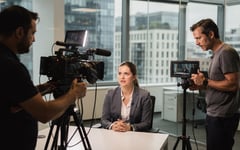


The client called twelve months after we wrapped to say the film looked wrong.
Not broken. Not technically poor. Just wrong. The office backdrop had been refurbished. The spokesperson had moved to a different role. The product had a new name. And the visual style, which in year one had felt considered and current, had started to date in a way that was hard to name but easy to see.
We had made a film that looked expensive in the month of its release and looked like a document of a prior era twelve months later.
That conversation changed how I think about what actually drives obsolescence in corporate film work. It is rarely the production quality. It is almost always a set of specific, avoidable decisions made at brief stage.
The factors that age fastest
Office interiors. The most common backdrop for corporate films produced in London is the company's own office. It communicates authenticity, and that is real value. It also commits the film, permanently, to the exact state of that office on the shoot day. If the rebrand happened in February, the film looks like a time capsule by March. If the fit-out changed, if the signage changed, if the whole feel of the space moved on, the film moves with it in the wrong direction.
Spokesperson role titles framed as permanence. "Our CEO, James, explains..." works well until James moves on or the CEO position changes. I have seen strong films effectively retired because the person speaking them no longer held the role they name in their opening line.
Technology references. A brand film that names a specific platform or tool commits to that tool's relevance. Some of those bets hold up. Others date the film so thoroughly that the mention becomes a distraction, even when everything else in the production still holds.
Visual trend compliance. There are production aesthetics that feel very much of a moment: a particular grade, a specific motion-graphic style, a choice of music that saturated commercial video for eighteen months before it became dated. Films made to feel current in a particular season tend to peak in that season.
What ages well
The film is shot in the company's own office, committing it permanently to the exact state of that space on the day, so a refurbishment or new signage dates it fast.
The film is shot against a controlled studio backdrop tied to no physical location, so the environment becomes a creative choice the team can update without a reshoot.
The factors that hold up are almost the inverse of the above. A controlled studio backdrop that is not tied to a physical location carries none of the ageing risk of an actual office. In a green-screen studio, the environment is a creative choice, not a documentary record of a particular day in a particular room. The background can be updated without a reshoot. The presenter, the script, the story all remain usable.
The spokesperson is framed by job title, so the film is effectively retired the moment that person moves on or the position changes.
The spokesperson is framed by what they do, describing a function that holds even when the org chart and the job titles change next year.
Spokesperson framing that describes what someone does rather than what their title is. "Kate leads our client relationships" ages better than "Kate is our Client Director". The first describes a function. The second describes a job title that may not exist in that form next year.
Outcome stories rather than tool stories. "We reduced onboarding time by a third" has a long shelf life. "We use Platform X to reduce onboarding time" has the shelf life of that platform's contract.
Craft decisions over trend decisions. A film edited and graded for clarity rather than for a particular moment's aesthetic preference holds its quality across years. It does not look like it was made last year. It looks like it was made by people who cared about the work.
The brief question that changes everything
When I am working through a corporate video london brief with a client, I now ask one question that rarely appears in a standard briefing document: what is the intended useful life of this film?
If the answer is twelve months, we make different decisions than if the answer is three years. A short-cycle piece might earn its trend-chasing, and the budget is proportionally lower. A flagship film built to anchor a website and represent the company to new prospects for multiple years needs a completely different set of decisions about set, framing, and visual language.
Most clients have never been asked this question before. Once they think about it, the answer changes almost everything they were about to specify.
The film we are now remaking
The film I described at the start is being replaced this year. We are shooting in a controlled studio environment, with spokesperson framing built to hold regardless of what the org chart looks like in year two. The backdrop will be a designed set, not a window into an office that will look different in six months.
Twelve months from now, the film will still look like it was made with care for a serious company. That is the only thing a brand film really needs to do.
If you want to see how that conversation changes a brief, we have production slots available this month.
Frequently asked questions
Why do corporate brand films date so quickly?
It is rarely the production quality. Films age because of specific brief-stage decisions, such as shooting in your own office, naming a spokesperson by job title, or chasing a short-lived visual trend.
Does shooting in our own office make the film age faster?
It can. The office backdrop ties the film to the exact state of that space on the shoot day, so a refurbishment, new signage or a changed fit-out dates it. A controlled studio backdrop carries none of that ageing risk.
How should we introduce our spokesperson so the film lasts?
Describe what the person does rather than their job title. "Kate leads our client relationships" ages better than "Kate is our Client Director", because a function holds even when titles change.
What one question should we answer before briefing a brand film?
Ask what the intended useful life of the film is. A twelve-month piece can earn its trend-chasing on a lower budget, while a flagship film built to last several years needs different decisions on set, framing and visual language.