
We watched it back in the boardroom on the Monday. The CEO had been good in the room, you could feel it on the day. On screen he looked like he was apologising for something. Washed out, slightly orange, eyes flicking down and right every few seconds, audio with a faint echo that made the whole thing sound like it was recorded in a stairwell.
Nobody said it out loud. They did not have to. The comms director looked at me. The CEO asked, carefully, whether "the camera was the problem". The camera cost more than my car. The camera was not the problem.
I have now watched this exact scene play out enough times to know it is almost never one big mistake. It is three small ones, none of which were anyone's job, all of which were fixable, and all of which made a competent leader look like he was filming a hostage video.
It was never the camera
The instinct after a bad recording is always to blame the kit. Buy a better camera, hire a fancier crew, throw money at the lens. I understand it, because the camera is the thing you can see. It is the wrong instinct.
A keynote that looks amateur almost always fails on the three things you cannot point at in the footage. Light. Sound. Eyeline. Get those three wrong on a phone and it still looks bad. Get those three right on a five-year-old camera and it looks like a film clients would actually trust.
So here is what actually went wrong that day, in order of how much damage each one did.
Mistake one, the light was doing nothing
The venue had ceiling lights. That was the entire lighting plan. Overhead venue light is the single most reliable way to make a confident person look tired and guilty. It drops shadows under the eyes, kills the colour in the face, and flattens everything so the speaker melts into the backdrop.
A face needs a key light it is roughly looking towards, a softer fill so the shadow side does not go black, and something to lift the background so the speaker is not glued to the wall behind them. None of that is exotic. All of it is invisible to the audience in the room and ruthlessly visible on camera. We had relied on the venue. The venue did not care how the recording looked. Why would it.
Mistake two, the sound came from the wrong place
The audio came off the venue's PA feed. It sounded fine in the hall, because a hall is built to fill with sound. A microphone hears the speaker plus the room bouncing back off every hard surface. That bounce is the echo we heard on the Monday, the thing that made a polished talk sound cheap.
A lapel or boom mic on the speaker, recorded separately, hears the voice and almost none of the room. It is a small box and a person who knows where to clip it. It is also the difference between a film someone forwards to the board and a film someone quietly closes after twenty seconds, because bad audio reads as low effort faster than bad picture ever does.
Mistake three, nobody owned the eyeline
This was the one that did the real harm, and the one that costs nothing to fix. He kept glancing down and to the side. To his notes. To a producer who was not there. To the floor. On screen, a leader who will not hold a line looks like a leader who does not believe it.
Eyeline is the cheapest credibility you can buy and the first thing an untrained shoot gets wrong. A single mark to look towards. One person stood by the lens whose only job is to be the thing he talks to. A run sheet that gives him a minute to settle before the take you keep, instead of rolling on the cold first attempt because the schedule was tight.
What changed on the reshoot
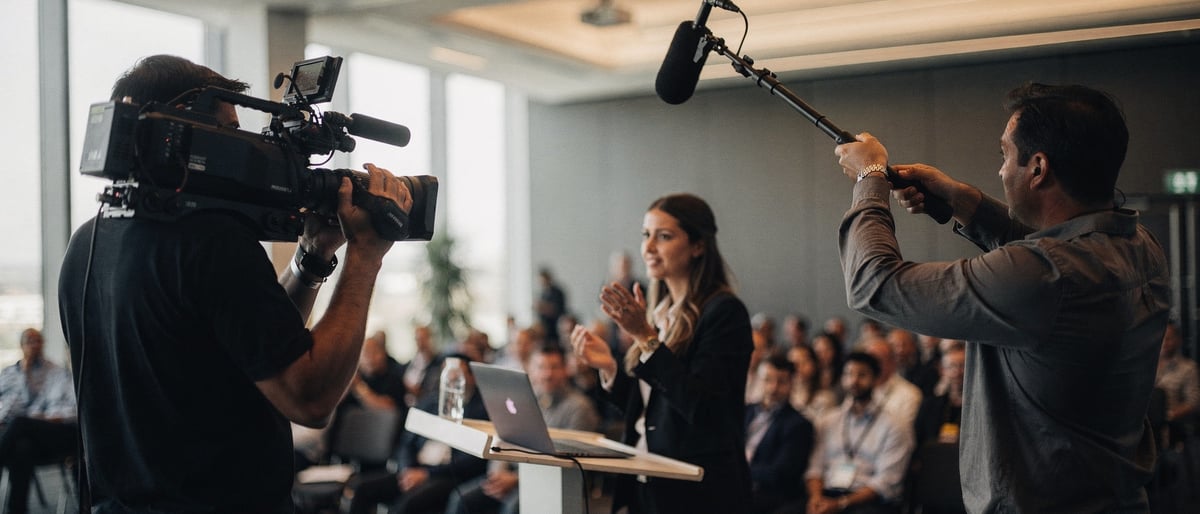
A borrowed venue lit by overhead ceiling lights, audio off the PA feed, and a CEO glancing down to notes and the floor with no eyeline to hold.
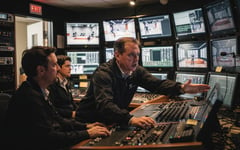
A London studio, light rigged for the camera not the room, a mic on the speaker, and one person stood by the lens whose only job was his eyeline.
We reshot it. Same CEO, same script, same week. A studio in London instead of a borrowed venue, light that was rigged for the camera and not the room, a mic on him, and one person stood by the lens whose entire job was his eyeline. He did not get better at presenting in four days. The film just stopped fighting him. The board saw the second version and asked who had "trained him up". Nobody had. We had stopped the room sabotaging him.
The fix you actually missed
The thing nobody put on the run sheet was an owner. Not a bigger budget. An owner. Someone whose job on the day was the recording, not the event. The event team is rightly obsessed with the room, the catering, the running order, whether the AV plays. The recording is treated as a thing that happens by itself in the background. It does not. It happens to you, badly, while everyone is busy with the room.
A keynote recording is a production with one job. If nobody owns the light, the sound and the eyeline, the venue owns them by default, and the venue's default makes your most senior person look like he borrowed someone's webcam. That is the loss. Not a wasted shoot day. A credibility hit, played to the exact audience you most wanted to impress, archived forever on the company channel.
Before your CEO's next keynote, do one thing. Decide who owns the recording, and make sure it is not the person also owning the room. If that person does not exist on your team yet, that is the gap, and it is a cheaper gap to fill than a reshoot. It is the difference between a keynote that looks like a webcam call and a film clients forward to the board.
If you have a keynote coming up and you want a second pair of eyes on the run sheet before the day, send us the date and we will walk you through what to lock down. No quote attached. Better to catch the three mistakes on paper than watch them back in the boardroom on the Monday.
Frequently asked questions
Was the camera really the problem with the keynote recording?
No. A keynote that looks amateur almost always fails on light, sound and eyeline, not the camera. Get those three right on a five-year-old camera and it looks like a film clients would trust.
Why did the audio sound like it had an echo?
The audio came off the venue's PA feed, so the microphone heard the speaker plus the room bouncing back off every hard surface. A lapel or boom mic on the speaker, recorded separately, hears the voice and almost none of the room.
What makes a speaker look untrustworthy on camera?
A wandering eyeline. Glancing down and to the side reads on screen as a leader who does not believe what they are saying. A single mark to look towards and one person by the lens fixes it for nothing.
What is the one fix to make before a CEO keynote?
Decide who owns the recording, and make sure it is not the person also owning the room. If nobody owns the light, sound and eyeline, the venue owns them by default, and the venue's default makes your most senior person look amateur.
Does a better lighting setup need expensive kit?
No. A face needs a key light it is roughly looking towards, a softer fill so the shadow side does not go black, and something to lift the background. None of it is exotic, and all of it is invisible to the audience in the room.