
Okay, so let’s start with the basics: spatial audio is sound that feels like it’s coming from around you, not just from the left and right. Think of it like stepping into a room rather than listening through a window. When it’s done right, voices and effects have direction, distance, and space. It’s not louder or fancier—it just feels more there.
At Disruptive Live, we mix everything—podcasts, livestreams, panels, explainers—with spatial audio by default. For us, it’s not a special feature. It’s just the way we work. And for the viewer or listener, it brings a sense of space that makes even simple content feel more present.
What Spatial Audio Actually Does
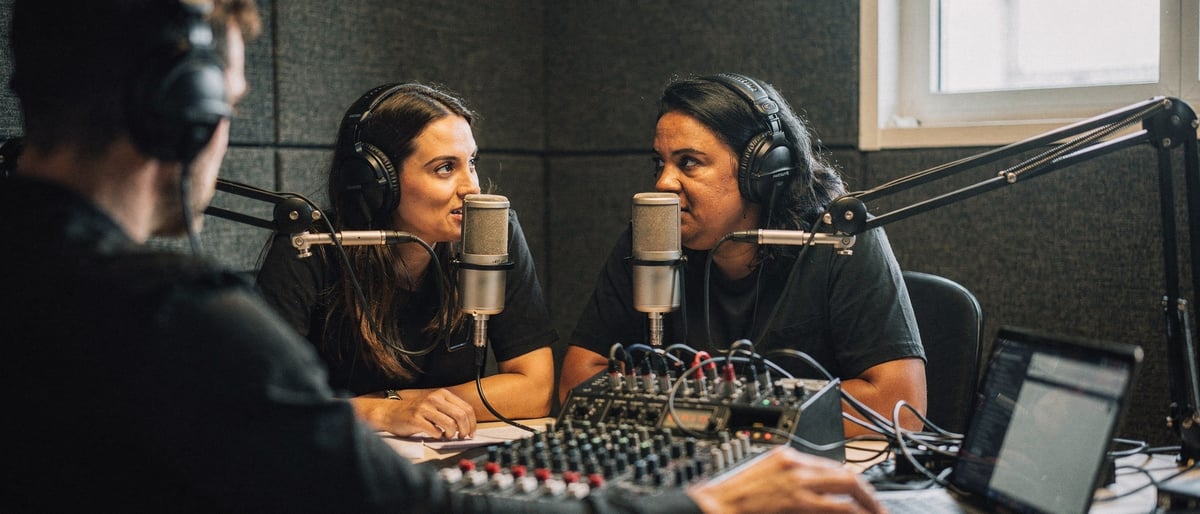
A panel of three speakers in a studio ends up sounding like a mush of voices, flat stereo with everything stacked in the centre.
Give each speaker their own place in the sound field, slightly left, slightly right, a bit further back, and it feels like you are sat with them.
Let’s take podcasts. A panel of three speakers in a studio can end up sounding like a mush of voices. But if you give each speaker their own place in the sound field—slightly left, slightly right, a bit further back—it suddenly feels more like you’re sat with them.
Same thing with video. A product demo can feel more polished if subtle sound cues guide attention. A documentary with background ambience spread out around the listener pulls them into the environment. Even a casual interview starts to feel richer when the room has some shape.
It’s not just a trick. It helps with clarity and engagement. The brain has an easier time sorting out what’s what when each sound has its own spot.
Where We’re At Now
Right now, spatial audio is available—but patchy.
Platforms And Playback Today
Platforms like Dolby Atmos and Apple’s Spatial Audio are leading the way. They let you mix sound in a virtual space—so you’re not just adjusting volume, but placing elements in a kind of 3D room.
Playback is still hit-and-miss. Apple Music supports spatial tracks. Netflix has spatial mixes for many shows. YouTube is experimenting with it. Spotify is… probably watching from the sidelines for now.
But a lot depends on how people are listening. Some headphones support spatial processing, some don’t. Some apps play nicely with spatial formats, others flatten it out. Sometimes a “spatial” experience is just clever stereo. Sometimes it’s the real thing.
Still, the tools are improving, and the listener base is growing.
Why We Use It as Standard
Spatial audio bolted on at the end, treated as a finishing trick after the content is already built.
Spatial audio baked in from the start, with voice placement and mix separation planned before filming begins.
At Disruptive Live, spatial audio isn’t bolted on at the end—it’s baked into how we build content from the start. If we’re filming a remote interview, we’ll plan voice placement in advance. If we’re recording a panel, we’ll separate out voices in the mix. And if we’re publishing an explainer, we’ll make sure supporting effects or background layers don’t crowd the dialogue.
We do this not to show off, but because it helps the content land better. Viewers stay focused. Listeners don’t zone out. And everything just sounds more considered—even if it’s being produced on a tight turnaround.
What’s Coming Next
Here’s where it gets interesting.
Tools And Hardware Ahead
More editing software is including spatial tools. Logic Pro now supports spatial mixing directly. There are plugins for Reaper, Pro Tools, and others. Dolby has cloud tools. And plenty of walkthroughs are popping up to help new users get started.
Platforms will keep expanding support. It’s not clear who will move fastest—Spotify? Amazon?—but once spatial becomes a default setting, not an upgrade, creators will need to keep up.
Also: hardware is changing. Apple’s head-tracked spatial audio already reacts as you move your head. Others are doing similar. It’s not hard to imagine future podcasts that respond to your movements, location, or environment. A bit niche right now—but the pieces are there.
What You Can Do Today
Even if you're not ready to dive into full spatial mixing, there are things you can start doing straight away.
Practical Steps To Start
1. Mix with space in mind. Use panning and EQ to give each voice or element its own place. Avoid the centre-stack mush.
2. Test with different headphones. Some budget models simulate spatial effects. Good to hear how your mix plays out in the real world.
3. Try spatial presets. Tools like Dolby.io or DearVR offer quick wins. Drop in a multitrack and experiment.
4. Learn by listening. Find podcasts and videos using spatial sound. Listen for what they’re doing with positioning, ambience, and transitions.
Preparing For What Comes
Even small changes in how you mix can help you prepare for a world where listeners expect more than flat stereo.
Get in touch with the team.
Frequently asked questions
What is spatial audio in plain terms?
It is sound that feels like it is coming from around you, not just from the left and right. Voices and effects have direction, distance and space, so content feels more present.
Does spatial audio just mean louder or fancier sound?
No. It is not louder or fancier. It gives each sound its own spot, which helps clarity and engagement because the brain finds it easier to sort out what is what.
Which platforms support spatial audio right now?
Dolby Atmos and Apple Spatial Audio lead the way. Apple Music supports spatial tracks, Netflix has spatial mixes for many shows and YouTube is experimenting with it. Playback is still hit and miss.
Do I need special headphones to hear it?
It depends on how you are listening. Some headphones support spatial processing and some do not, and some apps flatten it out. Sometimes a spatial experience is just clever stereo.
How can I start mixing with space in mind today?
Use panning and EQ to give each voice its own place and avoid the centre-stack mush, test across different headphones, try spatial presets from tools like Dolby.io or DearVR, and learn by listening to content that already uses spatial sound.