
The CEO stopped halfway across the studio floor, turned around, looked at the bare green wall behind him, and asked, completely seriously, whether that was honestly going to be the inside of his product on television.
It was. He was standing in front of nothing but green, which on the monitors in the gallery had already become the inside of his own product, with his city through a window that did not exist. He could see a flat green wall. The camera could not. That gap, between what the person in the studio sees and what the screen sees, is the entire job. Everything we build is in service of making that gap invisible.
I want to walk you through what is actually on the other side of that gap, because the parts that decide whether your video looks broadcast-ready are almost all the parts you never see.
The green screen is the easy bit
Everyone fixates on the green screen. It is the thing people picture when you say virtual studio. It is also, honestly, the least interesting decision we make. A green wall is a green wall. Put a presenter in front of one with the lighting wrong and the camera wrong and you have a very expensive webinar.
A green wall with the lighting and camera wrong gives you a very expensive webinar, and on camera slightly cheap reads as the whole brand.
Tracked cameras let the composited world move with the lens at the right speed and perspective, so a window behind the speaker behaves like a real window.
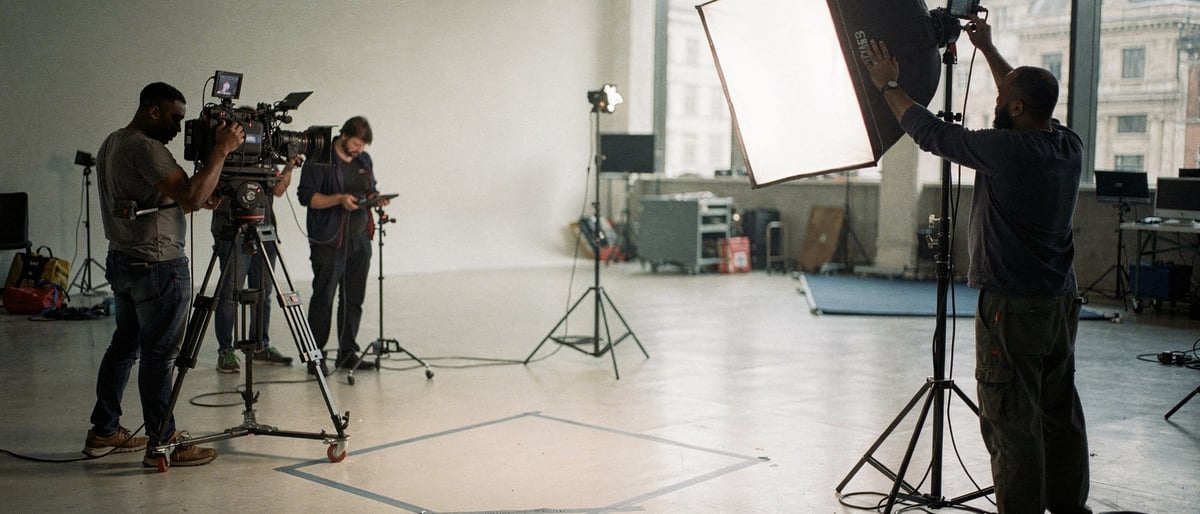
The green screen only earns its money when it is married to the camera. Our cameras are tracked, which means the system knows exactly where the lens is, where it is pointing, how far it has zoomed, every fraction of a second. When the camera moves, the world composited behind the speaker moves with it, at the right speed, with the right perspective, so a window behind the speaker behaves like a real window and not a photo taped to a backdrop. Get the tracking wrong by a hair and your eye knows immediately, even if you cannot say why. It just looks off. Slightly fake. Slightly cheap. And on camera, slightly cheap reads as the whole brand.
That is the part the CEO could not see, and the part that made him doubt a flat green wall could ever look like television.
Light is where the lie lives or dies
Here is the thing that took me an embarrassingly long time to understand. The most important kit in a virtual studio is not the green screen. It is the lighting, and specifically how the light on the person agrees with the light in the world behind them.
If the scene shows a warm London evening and the key light on the presenter is a flat cold white, your brain rejects it instantly. Nobody articulates it. They just trust the video less and they do not know that is what happened. So our crew spends real time, before anyone good is on set, matching the light on the face to the light in the scene. Direction, colour, softness, the lot. When it is right, you stop thinking about it. When it is wrong, you stop watching.
The fear worth naming here is specific. It is not that the set looks bad. A bad set is easy, everyone clocks it, you fix it. The dangerous one is the set that looks slightly unconvincing to a finance director or a journalist or a prospective hire, who cannot tell you why they did not quite buy it, and just quietly trusts you a little less for the next ten minutes. You never get that feedback. You only ever see the result, later, in a number that did not move.
The room you don't see is doing the work
A camera and a green screen give you footage of a person being filmed, with no pace and nothing holding it together.
A gallery vision mixing, audio and a producer calling shots gives you television, with cuts that land and sound you never notice.
Behind the set, out of every shot, is the part that actually makes it broadcast-ready: the gallery. Vision mixing, audio, the engineer watching the tracking, the producer calling it like a live programme even when it is not going out live. This is the difference between filming a person and making television. A camera and a green screen give you footage. A gallery gives you something with pace, with cuts that land, with sound you do not notice because nothing is wrong with it.
We built ours in central London on purpose, and not for the address. Your executive arrives, does the bit only they can do, and leaves in the same window of their day. No travel to a barn in the home counties, no half a day lost, no tired CEO by the time the camera is finally ready. Central London is not the glamour. It is the logistics that protect the one person whose energy you cannot fake.
What broadcast-ready actually means
People say "broadcast-ready" like it is a spec sheet. It is not. It is a feeling the viewer has and never examines: that this is real, this is serious, these people know what they are doing, I will keep watching. Every invisible thing on this list, the tracking, the matched light, the gallery, the producer calling shots, exists to produce that one unexamined feeling.
A set that looks real makes your message look true. A set that looks fake makes even a true message look like a sales deck.
What I'd check before you commit to any studio
If you are pricing a virtual set anywhere, do not ask about the green screen first. Ask three quieter questions. Are the cameras tracked, or is the background going to swim when the shot moves. Who is matching the lighting to the scene, and when. Is there a real gallery and a producer running it, or is it a screen and a camera and hope.
The answers to those three will tell you, before you spend anything, whether you are buying television or buying an expensive webinar with a nice backdrop.
If you want to see the invisible parts working with your own eyes, book a behind-the-scenes studio walkthrough and we will put you in the gallery during a live take, so you can watch the gap between the room and the screen disappear before you decide.
Frequently asked questions
What makes a virtual set broadcast-ready rather than just a green screen?
Broadcast-ready comes from the invisible parts working together, tracked cameras, lighting matched to the scene, and a gallery with a producer calling shots. The green screen itself is the least interesting decision.
Why do the cameras need to be tracked?
Tracking means the system knows exactly where the lens is and how far it has zoomed every fraction of a second, so the composited background moves with the camera at the right speed and perspective. Get it wrong and the shot looks slightly fake.
Why does the lighting matter so much in a virtual studio?
The light on the person has to agree with the light in the scene behind them. If a warm evening scene meets a flat cold key light, viewers reject it instantly and simply trust the video less without knowing why.
Why build the studio in central London?
Not for the address, for the logistics. Your executive arrives, does the bit only they can do and leaves in the same window of their day, with no travel to the home counties and no tired CEO by the time the camera is ready.
What should I ask before committing to any virtual set?
Ask three quieter questions rather than starting with the green screen. Are the cameras tracked, who is matching the lighting to the scene and when, and is there a real gallery with a producer running it.